Typed 1993 memo from the Arizona Republic library listing reader response counts for PressLine, contests and call-ins

Reader Connections at the Republic

In early 1993 I asked the Arizona Republic’s library to pull together numbers on how many readers were actually responding to the paper’s various ways of inviting them in — contests, call-ins, the PressLine audiotext service. Joanne Dawson, the librarian, came back with this tally, along with a sensible caveat about the state of the data.

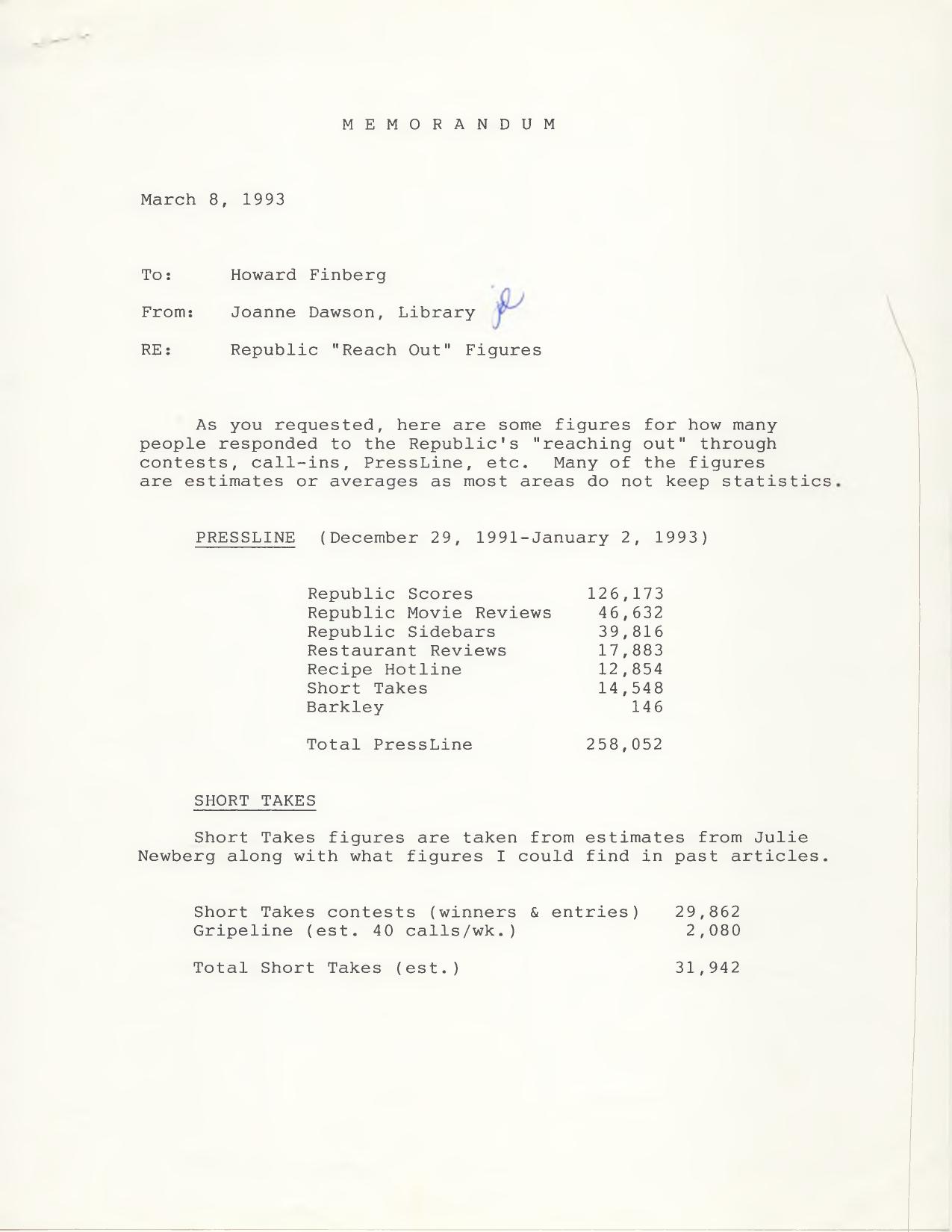
As you requested, here are some figures for how many people responded to the Republic’s “reaching out” through contests, call-ins, PressLine, etc. Many of the figures are estimates or averages as most areas do not keep statistics.

PressLine was the biggest piece, with 258,052 calls between December 29, 1991 and January 2, 1993. Sports scores dominated at 126,173, followed by movie reviews, sidebars, restaurant reviews and the recipe hotline. Short Takes, the Kids Page, sports phone-ins and a handful of contests filled out the rest.

GRAND TOTAL (est.) 334,790

What strikes me looking at this in 2026 is that almost nobody was keeping statistics. A third of a million reader interactions in a year, and most of it had to be reconstructed from old articles and someone’s best estimate of “40 calls/wk.” The audience was there and talking back — the newspaper just had no habit of measuring it. Web analytics would arrive soon enough and change that permanently.

February 1993 memo to Pam Johnson proposing a new approach to The Arizona Republic's Saturday edition

Rethinking the Saturday Republic

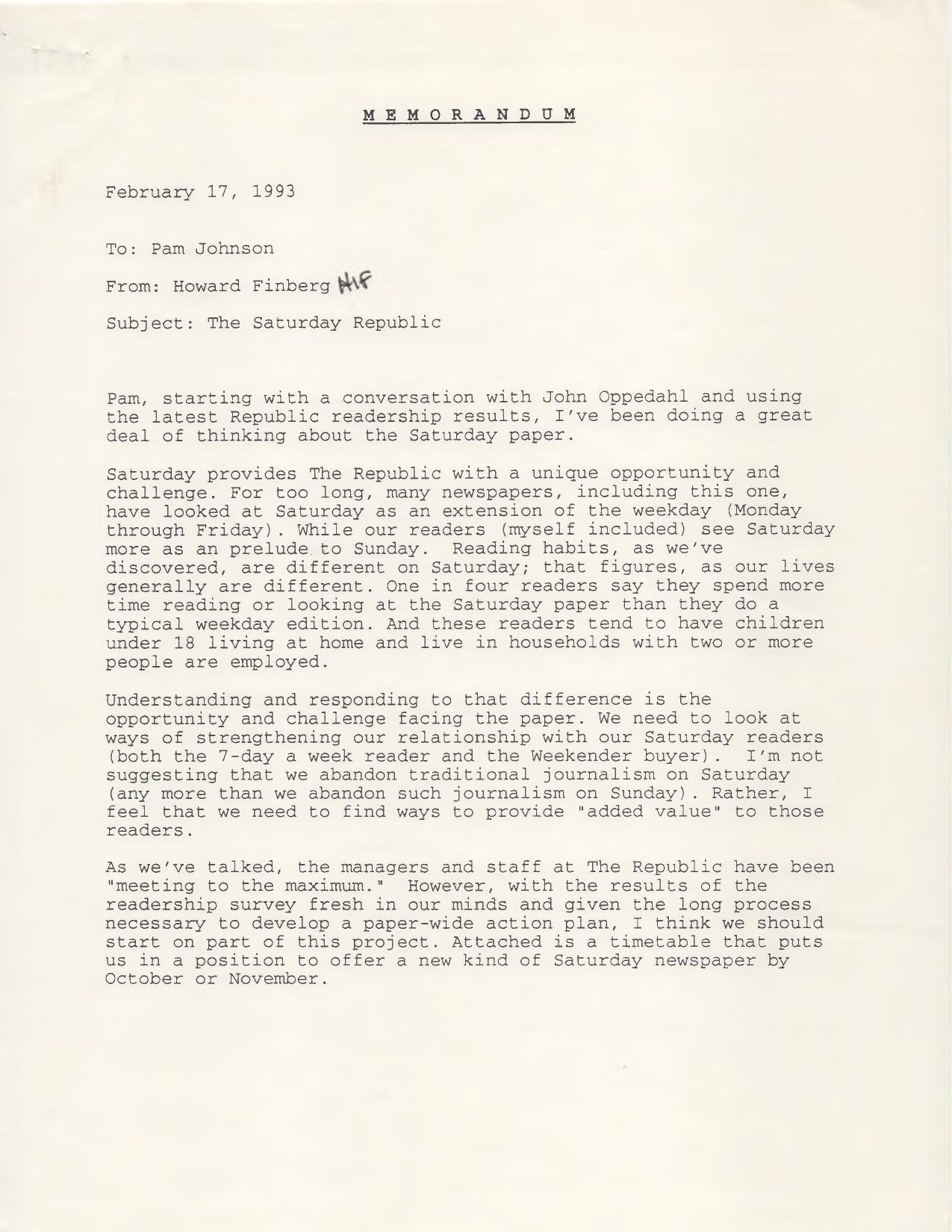
A February 1993 memo to Pam Johnson about the Saturday edition of The Arizona Republic. It grew out of a conversation with John Oppedahl and the paper’s latest readership research, which suggested Saturday didn’t behave like the rest of the week.

For too long, many newspapers, including this one, have looked at Saturday as an extension of the weekday (Monday through Friday). While our readers (myself included) see Saturday more as an prelude to Sunday.

The research point that mattered most: one in four readers said they spent more time with the Saturday paper than with a typical weekday edition — and those readers tended to have children under 18 at home and two or more people employed in the household.

Understanding and responding to that difference is the opportunity and challenge facing the paper.

I proposed a small working group — the right mix of “thinkers” and “doers” — naming Phil Hennessy, Susan Love, Bill Hill, Amy Carlile, Vinton Supplee, Judy Nichols and Diana Shantic. Among the content ideas: a Saturday centerpiece much like Sunday’s, a week in review feature, color comics, a feature for parents and kids to read together, home and garden and auto packages, personal finance, and health or fitness.

Attached was a timetable running from committee selection in February through research, prototypes, focus groups and marketing, with a launch of a new kind of Saturday newspaper by October or November.

Typed 1993 internal memo to Phoenix Newspapers executive John Oppedahl outlining questions for a meeting with America Online

An Early Look at America Online

This is a short memo I wrote in February 1993 to John Oppedahl, then an executive at Phoenix Newspapers, Inc., about a meeting I had scheduled with America Online. At the time, AOL was signing up newspapers to put content into its database, and I wanted to understand what such a partnership would mean for PNI before anyone committed to anything.

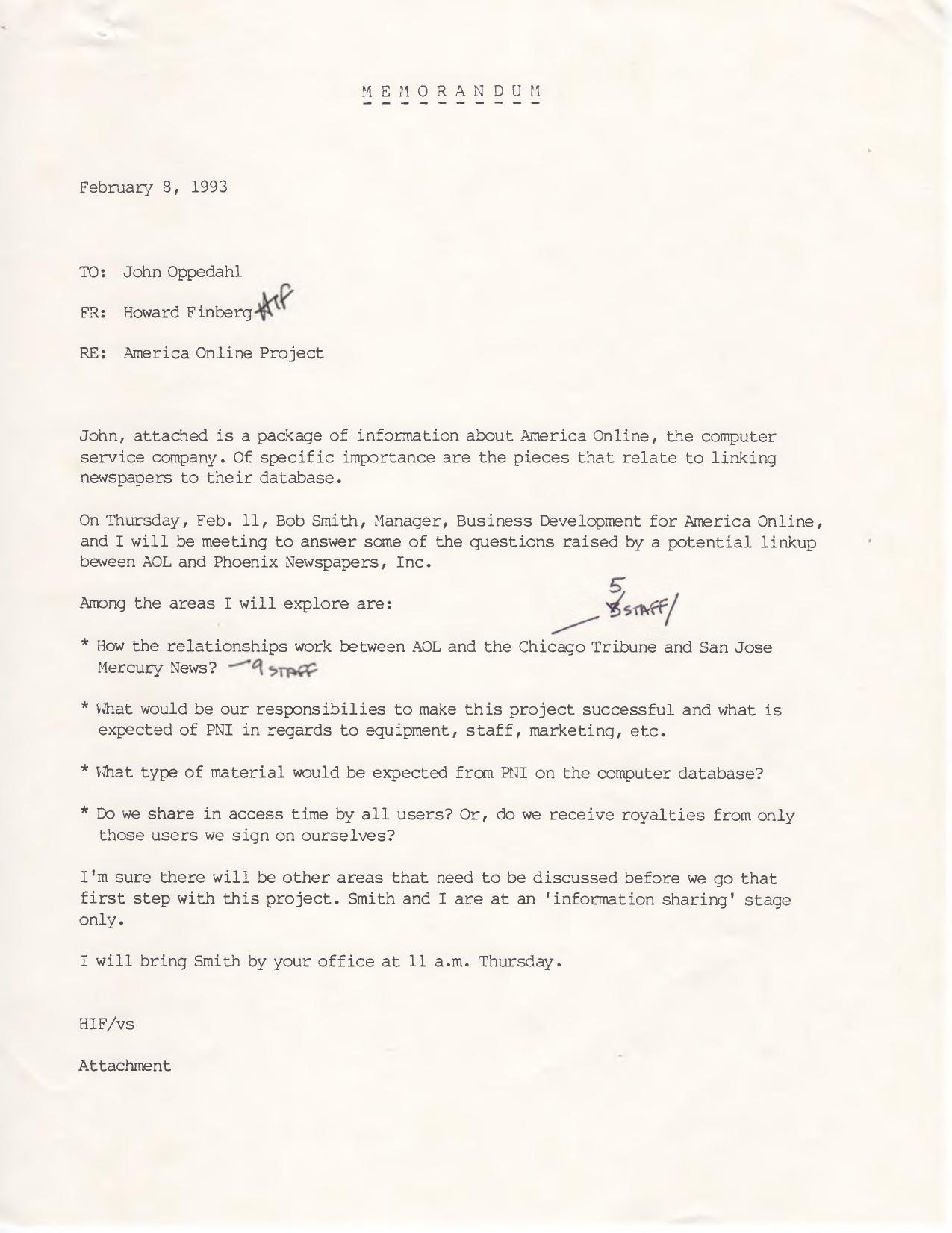
John, attached is a package of information about America Online, the computer service company. Of specific importance are the pieces that relate to linking newspapers to their database.

The meeting was set for Thursday, Feb. 11, with Bob Smith, Manager, Business Development for America Online. The questions I planned to ask were the basic ones any newspaper should have been asking in 1993 — and, honestly, the ones many didn’t ask carefully enough:

* How the relationships work between AOL and the Chicago Tribune and San Jose Mercury News?

* What would be our responsibilities to make this project successful and what is expected of PNI in regards to equipment, staff, marketing, etc.

* What type of material would be expected from PNI on the computer database?

* Do we share in access time by all users? Or, do we receive royalties from only those users we sign on ourselves?

That last question — who gets paid, and for whose audience — turned out to be the one the industry spent the next decade arguing about.

I was careful to keep expectations modest:

I’m sure there will be other areas that need to be discussed before we go that first step with this project. Smith and I are at an ‘information sharing’ stage only.

The memo closes with the smallest of logistical notes: I would bring Smith by Oppedahl’s office at 11 a.m. Thursday.

Postscript: Phoenix Newspapers did sign an agreement with America Online.

Tabulations from the 1988 Society of Newspaper Design membership survey, prepared by The Arizona Republic's Market Research Department and dated August 9, 1988

SND’s First Membership Survey, 1988

In 1988, as SND Region 7 director — and an assistant managing editor at The Arizona Republic — I put the Society of Newspaper Design’s first-ever membership survey into the mail. The tabulations were prepared by the Republic’s Market Research Department and dated August 9, 1988.

The pitch to members was straightforward:

We need your help. Enclosed is the first ever SND membership survey. This survey will be used to evaluate current Society programs and publications, identify the areas that should be expanded and help in the development of new services.

The methodology section explains the mechanics: a six-page self-completion questionnaire mailed to 1,500 domestic and 200 foreign SND members on May 25, 1988, with the total membership serving as the sampling frame.

There were 775 usable questionnaires returned for a response rate of 46 percent.

A few numbers that still stand out. Ninety percent said their newsroom or art/graphics department had one or more personal computers — and among those, 92 percent were using Macintosh to create graphics or illustration. Asked what would become more important at their newspaper in the next five years, computers topped the list at 89 percent, followed by informational graphics at 83 percent, design principles at 79 percent and color at 76 percent.

Members were also generous about the Society itself: 82 percent thought dues were “about right,” 64 percent said they always read Design journal, and 93 percent liked its magazine format. The soft spots were attendance and awareness — only 41 percent had been to a workshop or convention in the previous two years, and the most common reasons given were “too far away” and “too costly.”

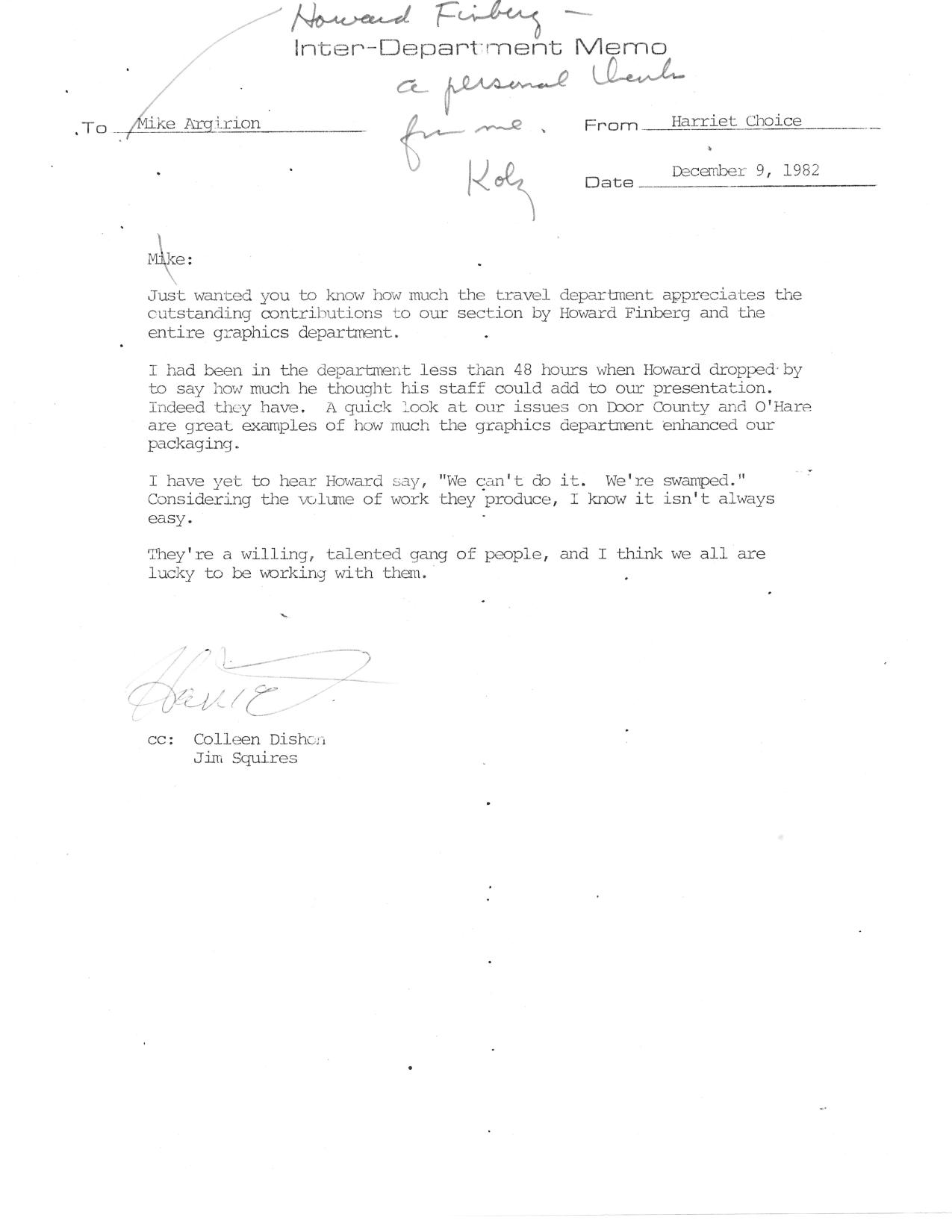
1982 Chicago Tribune inter-department memo from Harriet Choice thanking Howard Finberg and the graphics department

A Thank You Note From the Travel Department

An inter-department memo from the Chicago Tribune, dated December 9, 1982, from Harriet Choice to Mike Argirion, with copies to Colleen Dishon and Jim Squires. It’s a note of appreciation for the work the graphics department was doing for the travel section.

Just wanted you to know how much the travel department appreciates the outstanding contributions to our section by Howard Finberg and the entire graphics department.

She mentions two specific packages — the Door County and O’Hare issues — as examples of what the collaboration produced.

I had been in the department less than 48 hours when Howard dropped by to say how much he thought his staff could add to our presentation. Indeed they have.

My favorite line:

I have yet to hear Howard say, “We can’t do it. We’re swamped.” Considering the volume of work they produce, I know it isn’t always easy.

The credit belongs to the staff, not to me. As she put it:

They’re a willing, talented gang of people, and I think we all are lucky to be working with them.

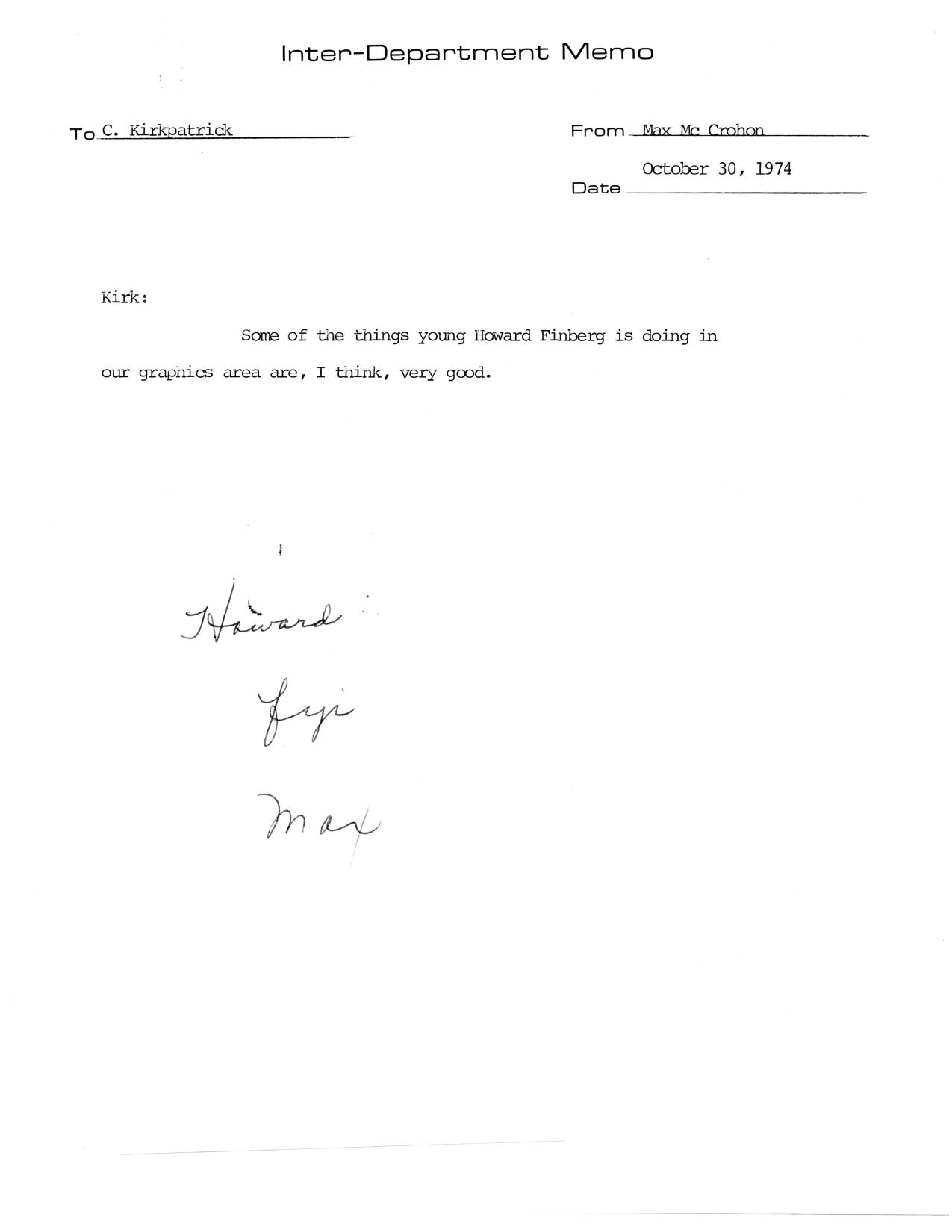
Chicago Tribune Inter-Department Memo dated October 30, 1974, from Max McCrohon praising Howard Finberg's work in the graphics area

A Short Note About Graphics

This is about as short as a memo can get, and it is a favorite document in the collection. Written on a Chicago Tribune Inter-Department Memo form, dated October 30, 1974, from Max McCrohon to C. Kirkpatrick. Two lines. That’s it.

Some of the things young Howard Finberg is doing in our graphics area are, I think, very good.

I was in the Tribune’s graphics area at the time, and “young” was accurate. Actually, I was the only graphics person at the paper. Getting noticed by the managing editor mattered, and getting it in writing mattered more — which is presumably why I kept a copy for the next fifty years. It was McCrohon who created the graphics editor job and put me in it.

What strikes me now is how much of a career can start with a sentence like this. Nothing in the memo says what those “things” were. But information graphics at newspapers were still being invented in the mid-1970s, and someone above me was paying attention.

Typewritten 1974 Chicago Tribune staff report titled Proposals for Improving the Chicago Tribune and Attracting Younger Readers

Attracting Younger Readers: 1974 Tribune Report

This is a staff report from my early days at the Chicago Tribune, titled “Proposals for Improving the Chicago Tribune and Attracting Younger Readers.” It carries the names of nine staffers: Ovie Carter, Gary Deeb, Howard Finberg, Clarence Page, Don Pierson, Bill Plunkett, Schickedanz, Rick Soll and Linda Winer. We were tasked to help the Tribune reach younger readers.  We were the younger staff members; I had been at the Trib for just about 2 years.

The introduction doesn’t ease into the problem. It opens with a description of how the paper was being seen from the outside:

Big, bulky. Impersonal. Stodgy. More concerned with things than people. As much fun as drinking cod liver oil (good for you but not so easy to swallow). Nearly devoid of any flair, flamboyance, or personality.

The committee’s argument was that this was a problem of perception and image more than content, and that the attitudes outside the building were mirrored by the attitudes inside it.

Simply stated, the Chicago Tribune takes itself too seriously. This is not to diminish its role as one of the nation’s best newspapers. Rather, it is a suggestion that the time has come for the Chicago Tribune to slaughter, once and for all, many of its sacred cows.

From there the report goes section by section — main news, editorial page, Perspective, Tempo, sports, business, the picture page, comics, Metro, the Sunday paper, copy editing, promotion. The recommendations are specific and, in places, blunt. A page one index every day. Long stories jumped to a designated jump page. A news-feature editor responsible for Column 1 and other offbeat material. Tempo remade from an old-fashioned women’s section into a daily “magazine-of-life,” preferably as an easy-to-handle tabloid pullout for the bus or train commuter. Entertainment and the arts displayed prominently rather than buried. A pop-culture column three times a week. Business pulled out as its own section. Sports writing tightened, with irreverence and humor encouraged.

The masthead got its own recommendation:

Removal of the flag would not necessarily attract new readership by itself. However, the slogan “World’s Greatest Newspaper” should be dumped. Its hyperbolic nature is unsuitable for the Tribune’s newly acclaimed progressive attitude of fairness and credibility.

The editorial page came in for the harshest treatment — described as the single most offensive part of the paper to young readers, with editorials characterized as “prairie populism” and “jumping jingoism.” The committee acknowledged that asking the paper to moderate its editorial stance might be impractical, then added a line I still like:

Editorial writers are advised that it is not always necessary to stand athwart progress hollering “Halt!”

What holds up best, reading it now, are the sections on people rather than packaging. The report faulted the paper for poor use of staff — writers forced to write formula stories, individual voices absorbed into what the report called “the Grey Blob,” and very little discussion between writers and editors about the quality of work. It also pressed on coverage of women and on Black and Latin communities, noting that most coverage of those communities “still consists of crime news, special series, and Operation PUSH,” and calling for the paper’s shortcomings there to be thoroughly investigated.

The closing borrowed the paper’s own advertising line:

To paraphrase the Trib’s current ad-promo line, “We need a friend in the Tribune.”

Fifty-plus years later, the questions in this report — how does a newspaper reach readers who don’t already have the habit, and how does it let its own staff sound like human beings — have never really gone away. Only the platforms changed.