Poynter NewsU faculty worksheet for the 100th webinar, "100 Ideas to Make Your Journalism Better," with instructions and slide guidelines

Planning the 100th NewsU Webinar

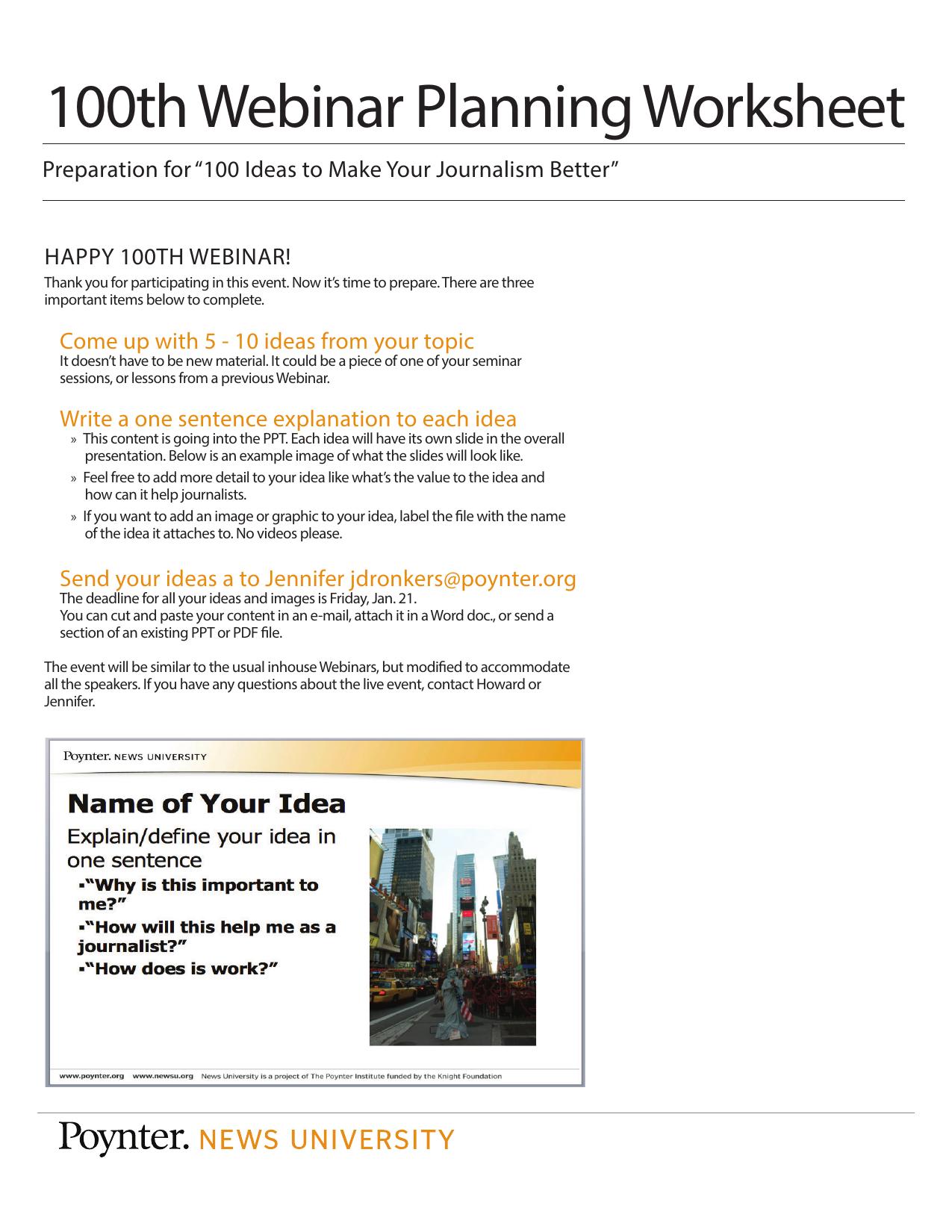
In January 2011 the Poynter NewsU team began planning a celebration of the 100th Webinar offered to journalists via News University, the project funded by the Knight Foundation. This is the worksheet faculty were given to help prepare their contributions.

The theme was a group effort, with each participant contributing a handful of ideas:

Preparation for “100 Ideas to Make Your Journalism Better”

The instructions were simple — and reassuring for busy faculty:

Come up with 5 – 10 ideas from your topic. It doesn’t have to be new material. It could be a piece of one of your seminar sessions, or lessons from a previous Webinar.

Each idea got its own slide, with a one-sentence explanation answering “Why is this important to me?” and “How will this help me as a journalist?” Ideas and images were due to Jennifer Dronkers by Friday, Jan. 21.

The event will be similar to the usual inhouse Webinars, but modified to accommodate all the speakers.

AEJMC News article page from November 2007 featuring educator testimonials on what e-learning can do through Poynter's News University

Beyond the Hype: What E-Learning Can Do for You

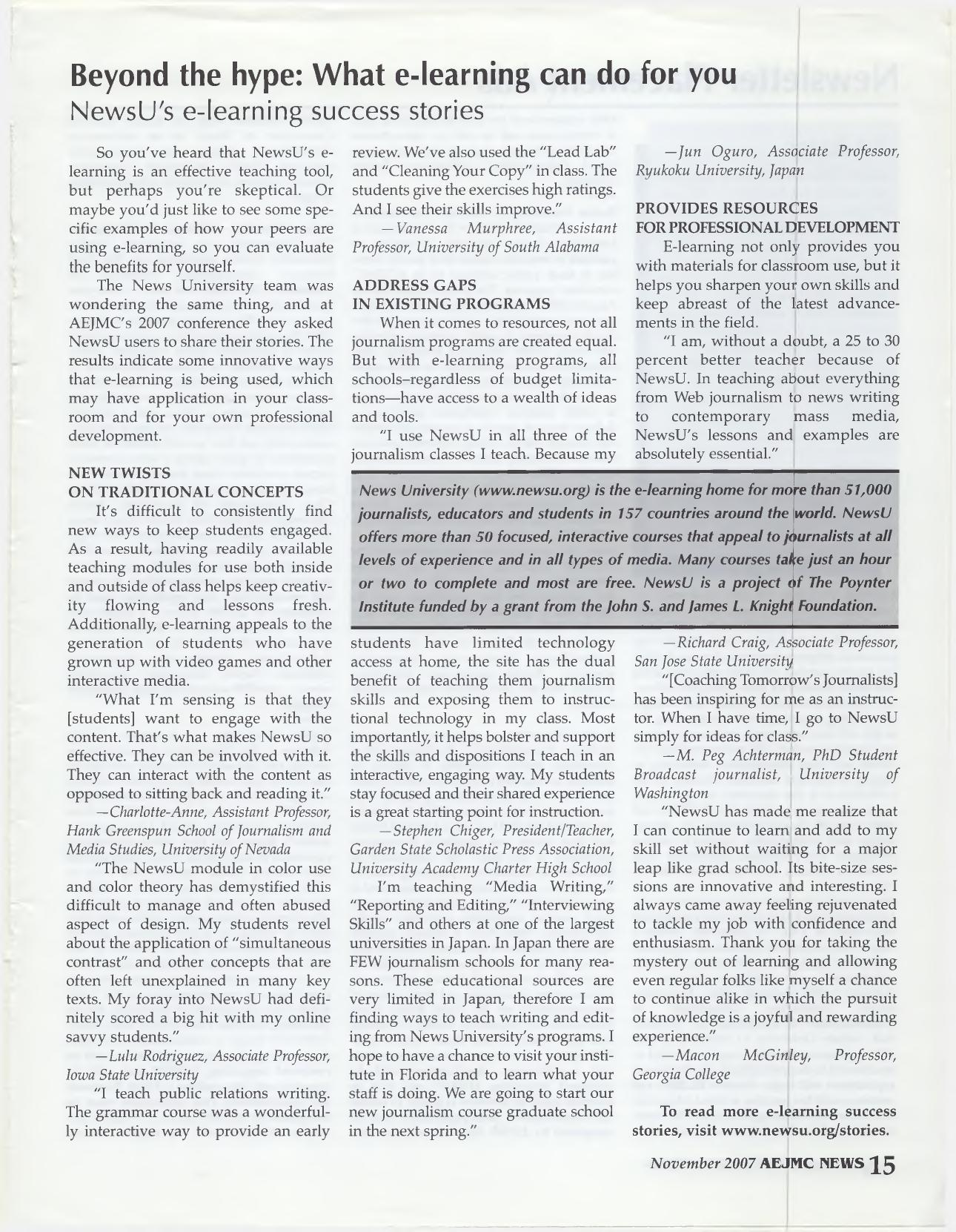
This is a piece that ran in the November 2007 issue of AEJMC News, built around testimonials the News University team collected from NewsU users at AEJMC’s 2007 conference. The idea was simple: rather than tell journalism educators that e-learning worked, let their peers say it.

The examples range from filling classroom gaps to sharpening the instructors’ own skills. A few that stood out:

“What I’m sensing is that they [students] want to engage with the content. That’s what makes NewsU so effective. They can be involved with it. They can interact with the content as opposed to sitting back and reading it.” —Charlotte-Anne, Assistant Professor, Hank Greenspun School of Journalism and Media Studies, University of Nevada

“The NewsU module in color use and color theory has demystified this difficult to manage and often abused aspect of design. My students revel about the application of “simultaneous contrast” and other concepts that are often left unexplained in many key texts.” —Lulu Rodriguez, Associate Professor, Iowa State University

“I am, without a doubt, a 25 to 30 percent better teacher because of NewsU. In teaching about everything from Web journalism to news writing to contemporary mass media, NewsU’s lessons and examples are absolutely essential.” —Richard Craig, Associate Professor, San Jose State University

One comment came from Jun Oguro, an associate professor at Ryukoku University in Japan, who noted that “In Japan there are FEW journalism schools for many reasons,” and that he was using News University’s programs to teach writing and editing.

The sidebar captures where NewsU stood at that point:

News University (www.newsu.org) is the e-learning home for [more] than 51,000 journalists, educators and students in 157 countries around the world. NewsU offers more than 50 focused, interactive courses that appeal to journalists at all levels of experience and in all types of media. Many courses take just an hour or two to complete and most are free. NewsU is a project of The Poynter Institute funded by a grant from the John S. and James L. Knight Foundation.

Fifty courses and 51,000 registered users was a milestone worth bragging about in 2007. By the time I left Poynter, both numbers had grown well beyond that. What strikes me reading this now, nearly two decades later, is how much of the skepticism we were answering — can online learning really teach anything? — has simply evaporated. That argument was settled by circumstance, not persuasion.

March 2006 awards write-up page describing the News University "It's All About U" starter kit campaign, with objective, tactics and results

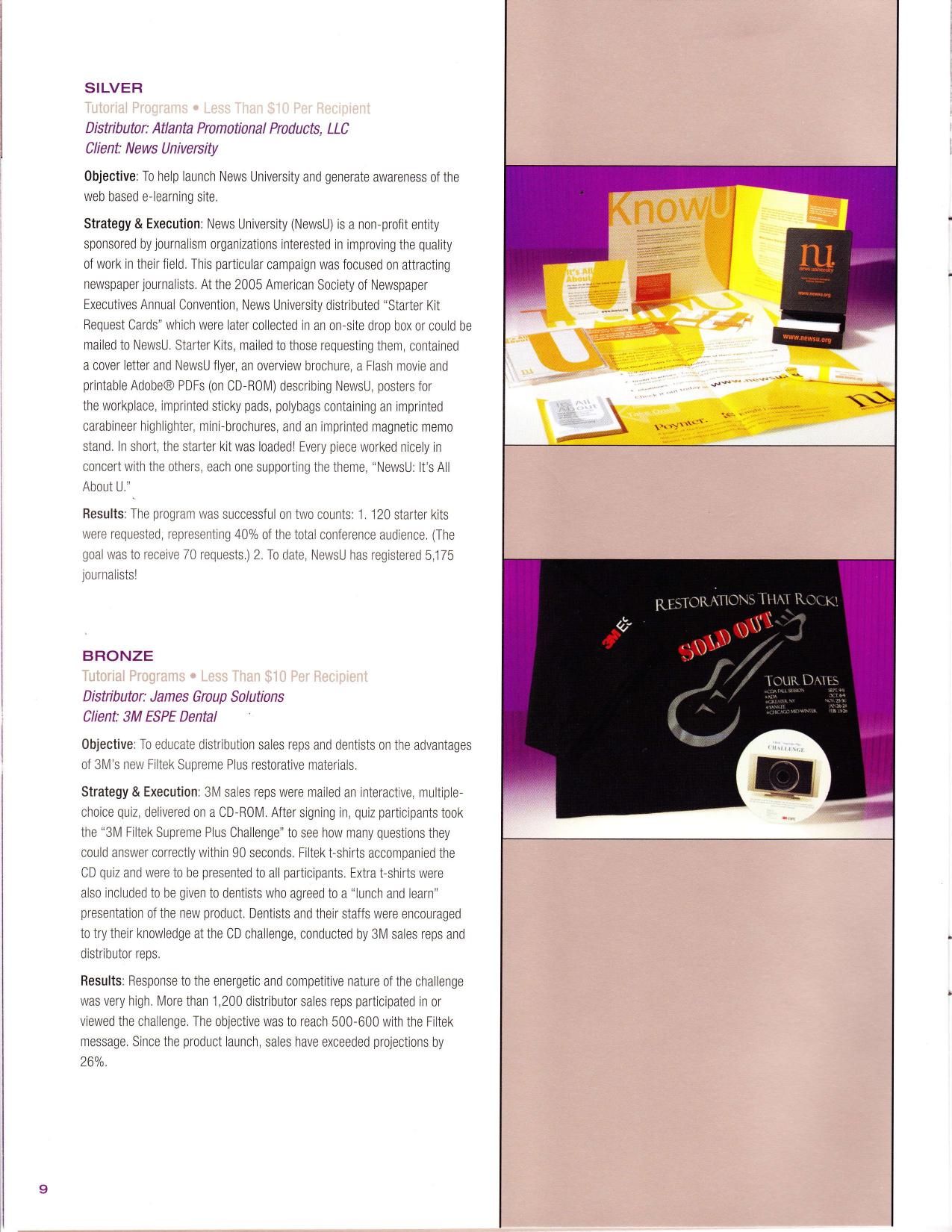
Silver Award for the NewsU “It’s All About U” Starter Kit

An awards write-up from March 2006 recognizing the promotional campaign built to launch News University, Poynter’s web-based e-learning site. The Silver award went to distributor Atlanta Promotional Products, LLC, with News University as the client. Credit for the campaign goes to Susan Crain, our NewsU marketing consultant.

The objective, as stated in the entry:

To help launch News University and generate awareness of the web based e-learning site.

The tactic was a request card handed out at a 2005 newspaper industry convention, with cards dropped in an on-site box or mailed back to us. Everyone who asked got a starter kit — and “kit” was not an overstatement:

Starter Kits, mailed to those requesting them, contained a cover letter and NewsU flyer, an overview brochure, a Flash movie and printable Adobe® PDFs (on CD-ROM) describing NewsU, posters for the workplace, imprinted sticky pads, polybags containing an imprinted carabineer highlighter, mini-brochures, and an imprinted magnetic memo stand. In short, the starter kit was loaded! Every piece worked nicely in concert with the others, each one supporting the theme, “NewsU: It’s All About U.”

The results section reports the campaign beat its goal:

120 starter kits were requested, representing 40% of the total conference audience. (The goal was to receive 70 requests.) 2. To date, NewsU has registered 5,175 journalists!

Reading this in 2026, the mechanics are the artifact. To market an online learning site, we mailed physical objects — a CD-ROM with a Flash movie, a poster, a magnetic memo stand — because that was how you reached working journalists in a newsroom. Today the entire funnel would be a link, an email sequence and a social post, and nobody would be counting drop-box cards at a convention.

What hasn’t aged is the underlying problem. In the early days of NewsU, the hard part was never building the courses; it was convincing journalists that online training was worth their time and that a self-paced course could be as good as sitting in a seminar room in St. Petersburg. That first 5,175 registrations was the beginning of a number that grew into the hundreds of thousands over the years that followed — but every one of them started with someone deciding to take a chance on learning at a screen.

Typed interoffice memo dated December 15, 2004 with the agenda for the Interactive Learning Steering Committee meeting at The Poynter Institute

Agenda for a NewsU Steering Committee Meeting, December 2004

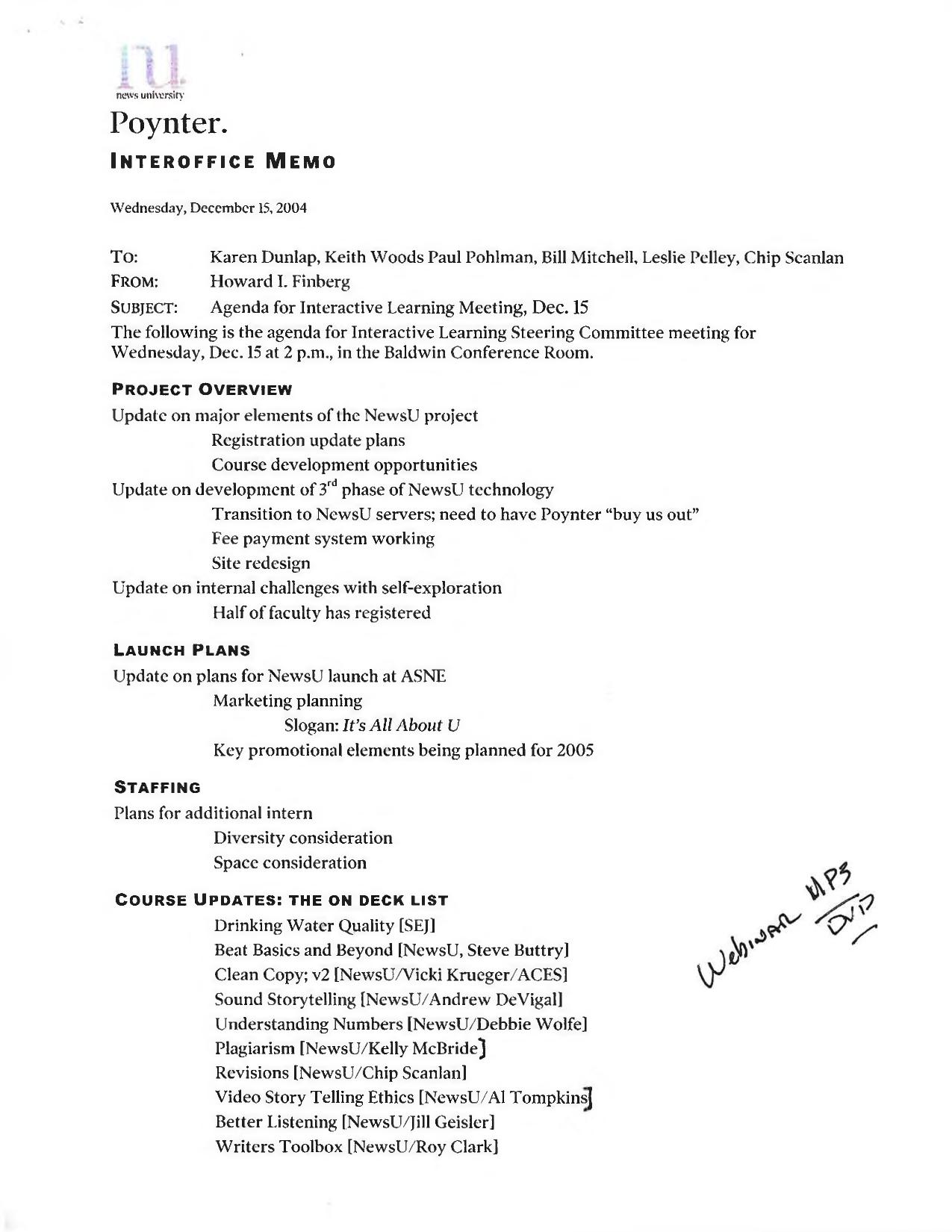
An interoffice memo from December 15, 2004, setting the agenda for the Interactive Learning Steering Committee meeting at The Poynter Institute. I sent it to Karen Dunlap, Keith Woods, Paul Pohlman, Bill Mitchell, Leslie Pelley and Chip Scanlan, with copies to Paige West, Casey Frechette, Vicki Krueger and Elizabeth Ferris. The meeting was set for 2 p.m. in the Baldwin Conference Room.

The agenda covers the project overview — registration, course development, the third phase of the NewsU technology, the transition to NewsU servers, the fee payment system and a site redesign — plus launch plans, staffing and an “on deck” list of courses in development. Among the internal challenges noted:

Update on internal challenges with self-exploration
Half of faculty has registered

Launch plans pointed to the American Society of Newspaper Editors, with marketing work already underway, including a slogan:

Slogan: It’s All About U

Courses on deck included Drinking Water Quality (SEJ), Beat Basics and Beyond (Steve Buttry), Clean Copy v2 (Vicki Krueger/ACES), Sound Storytelling (Andrew DeVigal), Understanding Numbers (Debbie Wolfe), Plagiarism (Kelly McBride), Revisions (Chip Scanlan), Video Story Telling Ethics (Al Tompkins), Better Listening (Jill Geisler) and Writers Toolbox (Roy Clark). Outreach partners listed AAJA, the Online News Association, the Society of Environmental Journalists, the Association of Health Care Journalists, the Education Writers Association, the American Copy Editors Society, the Dart Center, REZ Net and the Kaiser Foundation.

Attached to the agenda were enrollment and user reports as of noon that day. The ONA Training Project led with 410 students, followed by Language of the Image (260), The Interview (249), The Lead Lab (158), Handling Horrible Images (110), Color in News Design (78), Same-Sex Marriage: A Conversation About Coverage (49) and Crafting a Course: Developing eLearning for NewsU (13). Users came from the United States, Portugal, the Philippines, India, Canada, Brazil, Australia, the United Kingdom, Spain, Afghanistan, Albania, Nigeria, China, Poland, Romania, Chile and Ireland. By medium: print 55.45 percent, online 43.79 percent, television 13.4 percent, radio 9.06 percent. The most common way people heard about NewsU was the Poynter Online Web site.

NewsU development staff Elizabeth Ferris, Howard Finberg, J. Paige West and Casey Frechette, pictured in the Knight Foundation report feature on the Knight Chairs in Journalism

‘A World Full of Connections’ — Knight Foundation Report Feature on NewsU

A journalism feature from the John S. and James L. Knight Foundation annual report, looking at how the foundation’s endowed Knight Chairs in Journalism had begun collaborating with each other and with other Knight journalism partners — including The Poynter Institute‘s News University. The piece opens in St. Petersburg and traces the Knight Chair program back to 1990, when then-foundation president Creed Black announced its creation, saying it would strengthen the quality of American journalism education:

“by bolstering core curricular values and encouraging innovation.”

The story lists examples of that collaboration — Rosental Alves in Latin America, Jim Detjen at Michigan State, Charlotte Grimes at Syracuse, Melinda McAdams at Florida, Jacqui Banaszynski at Missouri, and Haynes Johnson’s work on the Knight-funded study Newsroom Training: Where’s the Investment? — before turning to what the report calls the largest gathering ever of Knight Chairs, who traveled to Poynter in 2004 to learn about News University.

a five-year, $2.8 million project to develop an e-learning program for journalists. The program is a partnership between Knight and Poynter, rated the nation’s top journalism training organization by the Where’s the Investment? study.

At the Poynter meeting the chairs brainstormed course ideas — how to analyze government data, how to understand scientific claims — and the article notes that work began immediately with William Gaines, the Knight Chair in Investigative and Enterprise Reporting at the University of Illinois, on an investigative documents class. The individual web sites of the Knight Chairs were to be promoted through the Learning Links page at NewsU.

The feature describes the official launch at the April 2005 American Society of Newspaper Editors convention, designed to make the case that NewsU is not just informative but a fun resource — “like thousands of journalists at a dinner party” — featuring material from 18 Knight Chairs in Journalism, a Lee Hills Chair in Free Press Studies and a Knight Professor in Constitutional Law and First Amendment. Elsewhere in the report, Reznet’s Dennis McAuliffe Jr. describes his own project’s plan to work with NewsU on a distance-learning course.

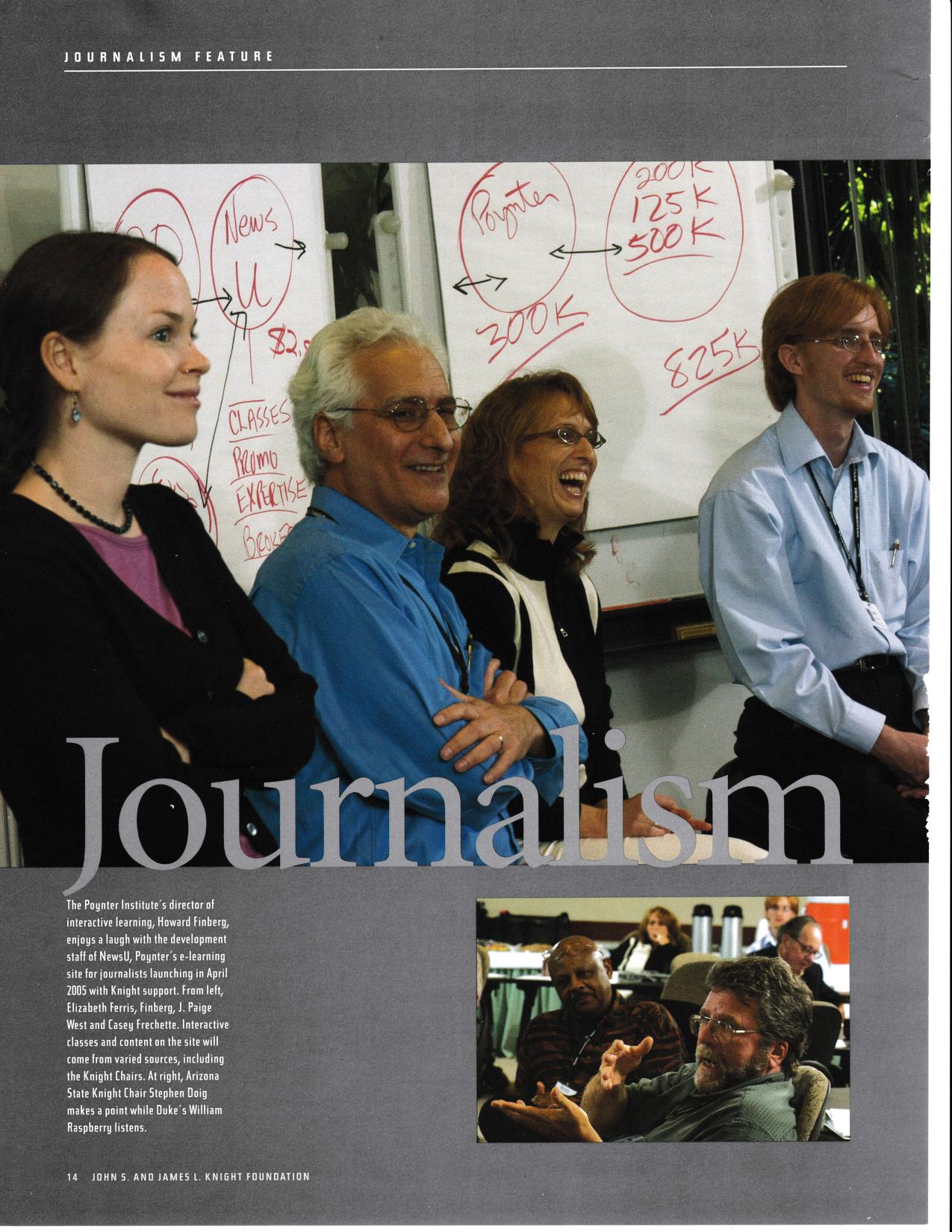
The photo caption identifies the NewsU development staff at the time — Elizabeth Ferris, Howard Finberg, J. Paige West and Casey Frechette. The story ends with a line that gave the feature its title:

“Journalism,” Finberg said, “is a world full of connections.”

1994-era Poynter memo proposing a seminar on the first 10 years of news on the Web

Proposal For the Web+10 Seminar at Poynter

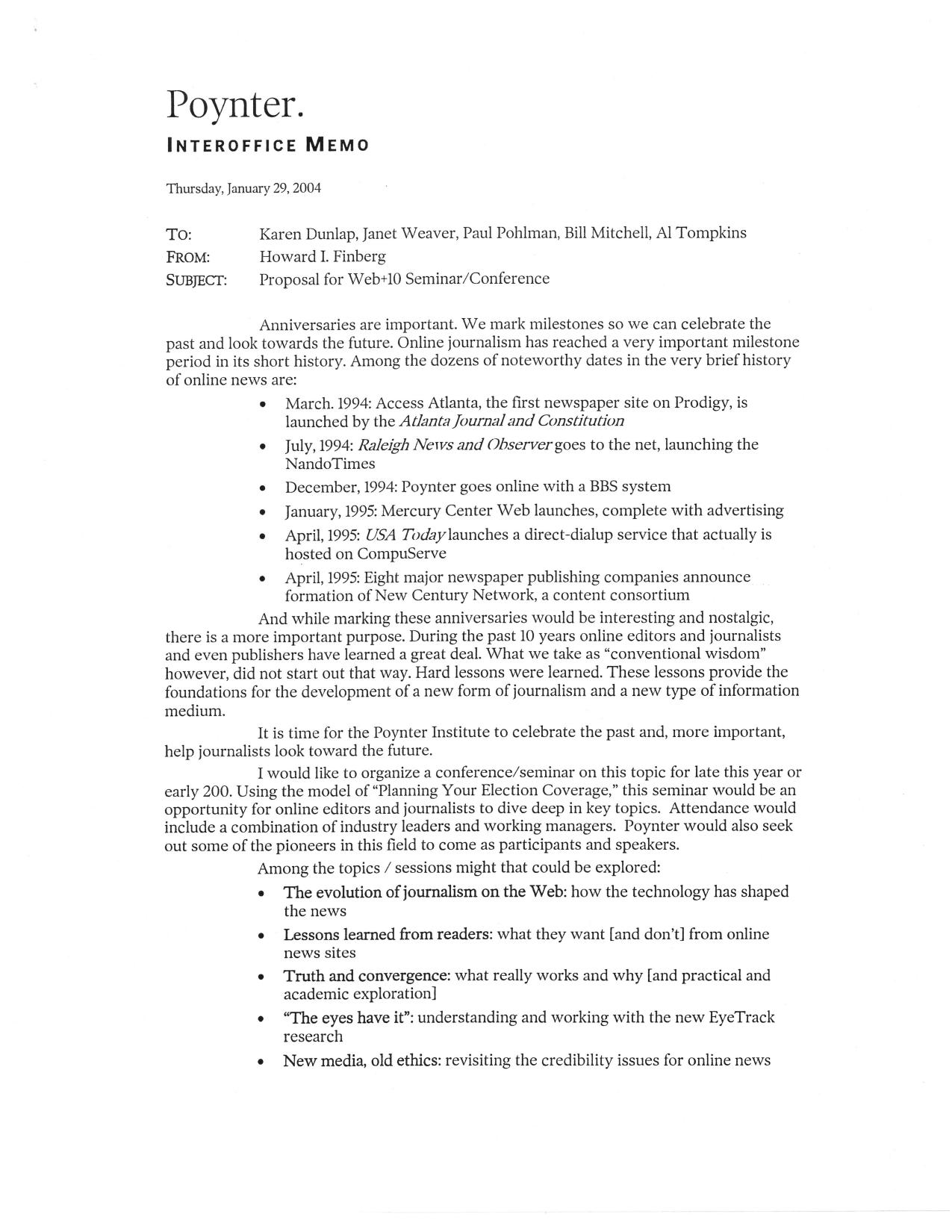
This is an interoffice memo I wrote at the Poynter Institute in January 2004, proposing a seminar to mark — and, more usefully, to learn from — the first 10 years of news on the Web. It went to Karen Dunlap, Janet Weaver, Paul Pohlman, Bill Mitchell and Al Tompkins, with copies to a number of colleagues working on Poynter Online and News University.

The premise was simple:

Anniversaries are important. We mark milestones so we can celebrate the past and look towards the future.

I laid out a short list of the dates that felt like the founding moments of online news: Access Atlanta launching on Prodigy in March 1994, the Raleigh News and Observer’s NandoTimes in July 1994, Poynter going online with a BBS in December 1994, Mercury Center Web in January 1995 (“complete with advertising”), USA Today’s dial-up service in April 1995, and the announcement that same month of New Century Network by eight major newspaper publishing companies.

But nostalgia wasn’t the point. What we had come to accept as conventional wisdom by 2004 had been paid for the hard way:

What we take as “conventional wisdom” however, did not start out that way. Hard lessons were learned. These lessons provide the foundations for the development of a new form of journalism and a new type of information medium.

The proposed format borrowed from Poynter’s “Planning Your Election Coverage” seminar — a mix of industry leaders and working managers, plus some of the pioneers of the field as participants and speakers. The session ideas ranged from the evolution of journalism on the Web to what readers actually wanted from news sites, convergence, the new EyeTrack research, credibility and ethics, changing media habits, “Sight and sound: the emerging Web senses,” and the interactivity challenge I titled “You provide, but I drive.”

I also wanted the seminar to be more than a room in St. Petersburg. The idea was to extend the conversation before and after the in-person meeting using News University as a platform, carry the teaching into Poynter Online, and possibly publish a special Poynter Report as a handbook “to guide online journalism into the next 10 years.”

The postscript is my favorite part of the memo. Just after I finished writing, Robin Sloan posted an item to Convergence Chaser about New York Times Digital CEO Martin Nisenholtz speaking about… Pong. Nisenholtz argued that nytimes.com would evolve

from sorting, distributing and making accessible content created principally for other formats, to creating content that is native to the computing world from which we evolved.

My reaction, in the memo: we needed to bring him to Poynter to explore what “native content” meant for journalists and journalism.

Reading this now, the milestone list looks impossibly early and the questions look impossibly current. We’re well past Web+30, and we are still arguing about credibility, about who drives the experience, and about what content native to a new platform actually looks like — only now the platform is generative AI rather than the browser.
First page of the 2004 Poynter Institute strategy document listing the mission statement and four strategies

Big Pieces for Poynter Strategy, 2004

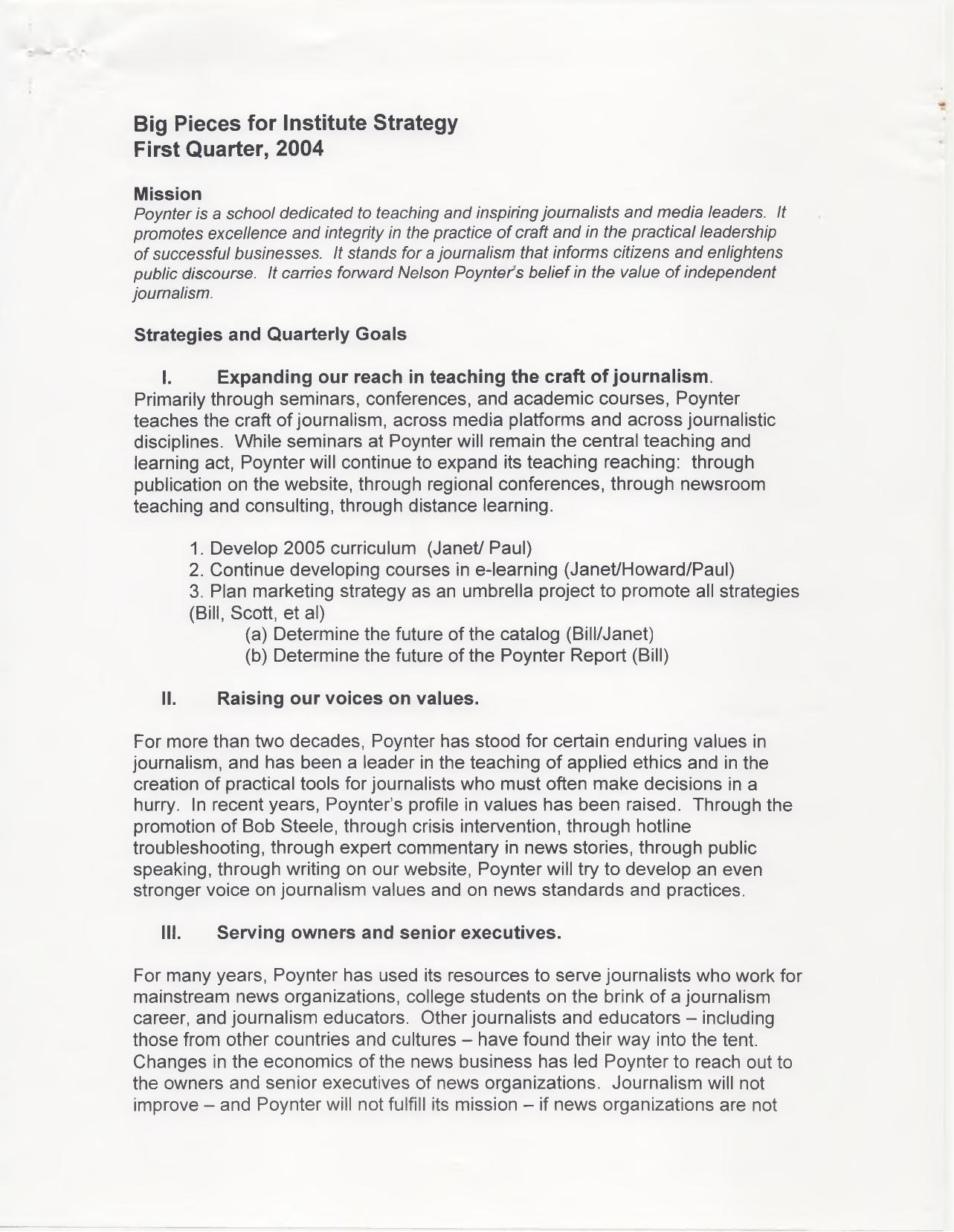
A two-page strategy document prepared for a Poynter Institute strategy session, dated January 15, 2004. It sets out the Institute’s mission and then four strategies, each with quarterly goals and named owners.

The mission statement opens the document:

Poynter is a school dedicated to teaching and inspiring journalists and media leaders. It promotes excellence and integrity in the practice of craft and in the practical leadership of successful businesses. It stands for a journalism that informs citizens and enlightens public discourse. It carries forward Nelson Poynter‘s belief in the value of independent journalism.

The four strategies: expanding the reach of teaching the craft of journalism; raising Poynter’s voice on values; serving owners and senior executives; and building the base at Poynter. Under the first, one of the numbered goals reads simply:

Continue developing courses in e-learning (Janet/Howard/Paul)

On the ethics side, the document describes Poynter’s long-standing role in the teaching of applied ethics and the creation of practical tools for journalists “who must often make decisions in a hurry,” and points to Bob Steele, crisis intervention, hotline troubleshooting, and expert commentary as the vehicles for a stronger voice on news standards and practices.

The third strategy marks the reach toward a new constituency:

Changes in the economics of the news business have led Poynter to reach out to the owners and senior executives of news organizations. Journalism will not improve and Poynter will not fulfill its mission if news organizations are not profitable and if journalists lack the resources they need to carry out their public service.

The final strategy is about the Institute itself: faculty and staff, campus, savings, and revenue, including hiring a development officer, partnerships, and re-evaluating tuition policies. It contains the line that best captures the place:

Poynter is a school that owns a newspaper, which keeps Poynter real, and brings to it resources in the form of stock dividends.

Sadly, things really didn’t work out for the newspaper or the Institute, which would go through a number of revenue models.


Letter page dated September 23, 2002 from Jim Naughton to the National Advisory Board, with three bulleted items and three small image thumbnails beneath.

“Yes, I’m Becoming a Convert to E-Learning”

I first came to Poynter as a visiting scholar, hired by the Institute’s president, Jim Naughton. This memo went to the National Advisory Board and Poynter staff ahead of its meeting, and it is Naughton making the case for distance learning.

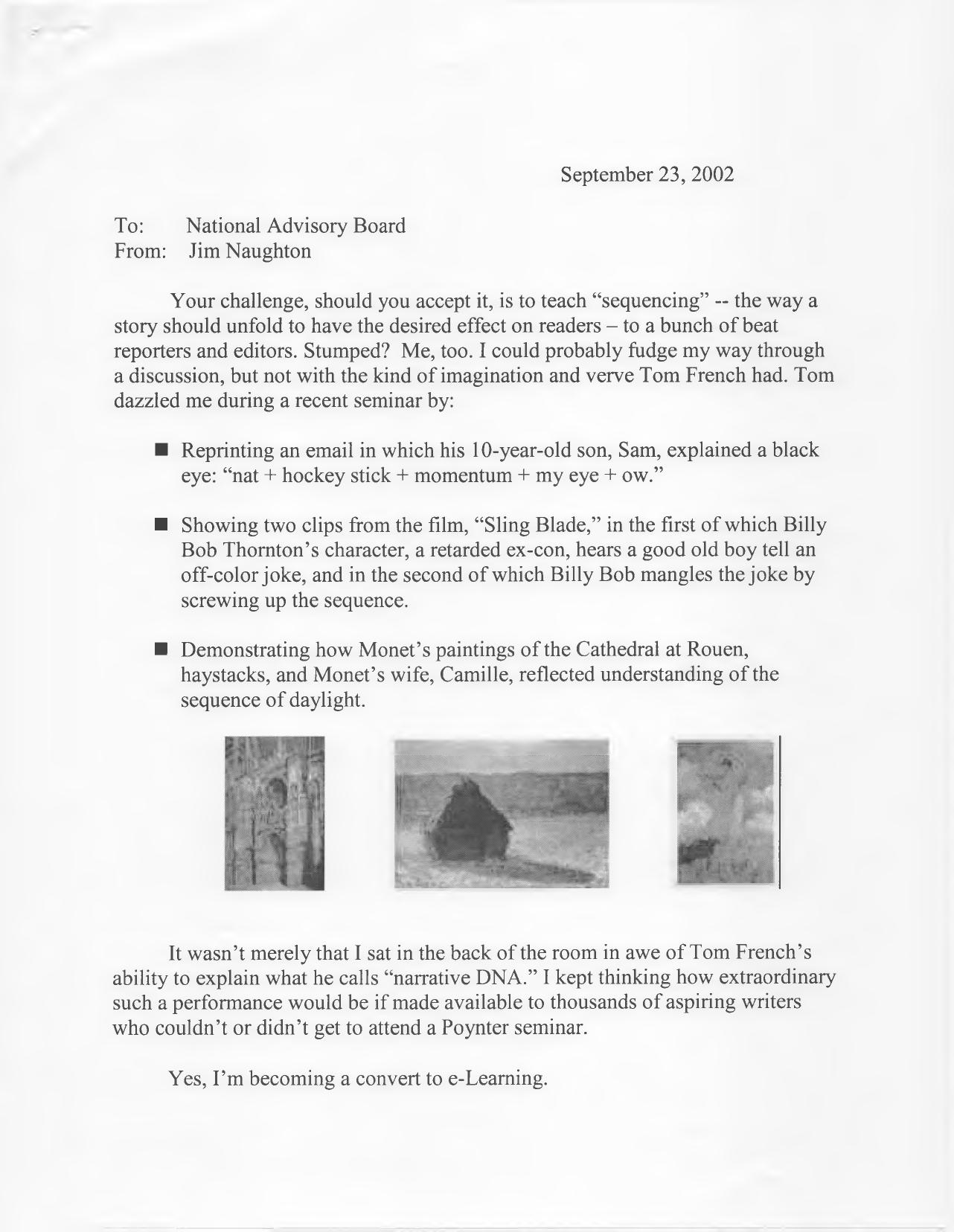
He opens with the challenge of teaching “sequencing” to beat reporters and editors, admits he’d fudge it, then describes how Tom French did it in a seminar — an email from French’s 10-year-old son explaining a black eye (“nat + hockey stick + momentum + my eye + ow”), two clips from “Sling Blade,” and Monet’s paintings of the cathedral at Rouen. What stayed with Naughton was the size of the room:

I kept thinking how extraordinary such a performance would be if made available to thousands of aspiring writers who couldn’t or didn’t get to attend a Poynter seminar.

Yes, I’m becoming a convert to e-Learning.

The memo notes that Dean Karen Dunlap had briefed the Board of Trustees on the faculty’s exploration of distance learning — “less structured, more self-guided” than what API and others were doing — and recounts Naughton emailing Hodding Carter at the Knight Foundation about collaborating. Carter replied almost immediately that the suggestion “comes at a good time”:

Eric Newton of Knight followed, saying they had been “thinking about Poynter as perfect” to collaborate on what they called “News University.” Naughton’s aside: “News U. Has a certain ring to it.”

And then my name appears, which is why this document is in my files:

As a Poynter visiting scholar, Howard Finberg has guided a faculty task force in considering e-learning. He’s drafted a report outlining our next steps and providing a focus for our discussions with the Knight Foundation.

Naughton’s closing was cautious — “We’ll see where this palaver goes” — but he saw the potential in combining Knight resources and Poynter teaching.