Come Together: Defining the Complementary Roles of Print and Online

In 2001 I worked with the Newspaper Association of America’s circulation federation to develop a report on how print and online departments could work together to further the sales of subscriptions.  Working with me on the project was my consulting partner at that time, Leah Gentry.

From the report’s opening:

… the NAA Circulation Federation began looking at how consumers use print and online news sources and how their choices affect our business. We began looking at the challenges and opportunities both media would encounter as this new consumer channel developed.

Here’s what we wrote for the introduction to the report, which runs 72 pages.

Newspaper marketing executives confront more challenges and opportunities as the media landscape evolves at an ever-increasing pace. No longer can our audiences be solely identified as newspaper readership; online also is becoming an important path for customers to access news and information. As our customers select from an increasing number of routes to us, we conversely enjoy expanded opportunities for marketing to them through multiple routes and for using each platform to strengthen its siblings.

When we wrote the report, pay walls and online subscriptions were just a glimmer on the digital horizon.
The report is too large to load here, so I’ve put in my SlideShare account.
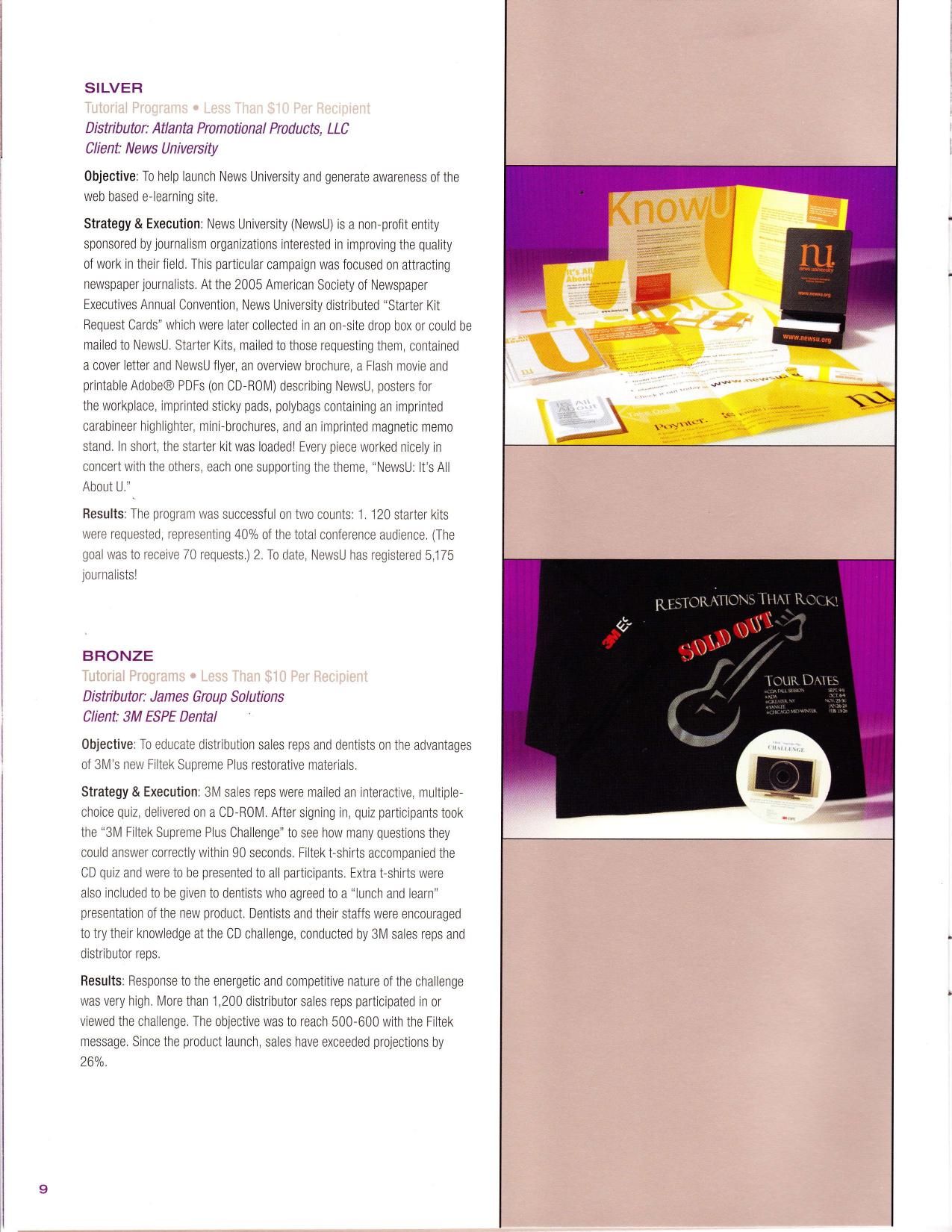
March 2006 awards write-up page describing the News University "It's All About U" starter kit campaign, with objective, tactics and results

Silver Award for the NewsU “It’s All About U” Starter Kit

An awards write-up from March 2006 recognizing the promotional campaign built to launch News University, Poynter’s web-based e-learning site. The Silver award went to distributor Atlanta Promotional Products, LLC, with News University as the client. Credit for the campaign goes to Susan Crain, our NewsU marketing consultant.

The objective, as stated in the entry:

To help launch News University and generate awareness of the web based e-learning site.

The tactic was a request card handed out at a 2005 newspaper industry convention, with cards dropped in an on-site box or mailed back to us. Everyone who asked got a starter kit — and “kit” was not an overstatement:

Starter Kits, mailed to those requesting them, contained a cover letter and NewsU flyer, an overview brochure, a Flash movie and printable Adobe® PDFs (on CD-ROM) describing NewsU, posters for the workplace, imprinted sticky pads, polybags containing an imprinted carabineer highlighter, mini-brochures, and an imprinted magnetic memo stand. In short, the starter kit was loaded! Every piece worked nicely in concert with the others, each one supporting the theme, “NewsU: It’s All About U.”

The results section reports the campaign beat its goal:

120 starter kits were requested, representing 40% of the total conference audience. (The goal was to receive 70 requests.) 2. To date, NewsU has registered 5,175 journalists!

Reading this in 2026, the mechanics are the artifact. To market an online learning site, we mailed physical objects — a CD-ROM with a Flash movie, a poster, a magnetic memo stand — because that was how you reached working journalists in a newsroom. Today the entire funnel would be a link, an email sequence and a social post, and nobody would be counting drop-box cards at a convention.

What hasn’t aged is the underlying problem. In the early days of NewsU, the hard part was never building the courses; it was convincing journalists that online training was worth their time and that a self-paced course could be as good as sitting in a seminar room in St. Petersburg. That first 5,175 registrations was the beginning of a number that grew into the hundreds of thousands over the years that followed — but every one of them started with someone deciding to take a chance on learning at a screen.