This is a report I put together in August 1996 for managers at Phoenix Newspapers who didn’t quite understand what “going online” meant — or where it was headed. Rather than argue in the hallway, I built a briefing book: talking points, traffic charts, a project list, revenue and expense projections, and a stack of clippings from the trade and business press so no one had to take my word for the direction of the market.
The first section is organized around questions from Chip Weil, then President and CEO of Central Newspapers, with my answers filled in:
I’ve taken some of Chip Weil’s questions [the italics] and added some general answers and/or talking points that could be discussed at the meeting. Marilyn Tanious was helpful regarding some key points that should be discussed.
Most of the questions were about classified advertising — real estate and employment — which was where the money was and where the threat was. The report notes on-going discussions with the area’s multiple listing service [ARMLS] for complete property-for-sale data, work on getting employment display advertising online, more “Virtual Job Fairs” starting in September, an outside company [Moore Data] on a rentals database, and an automotive push with the AIG group and with Bill Luke, which wanted to put its used-car inventory online.
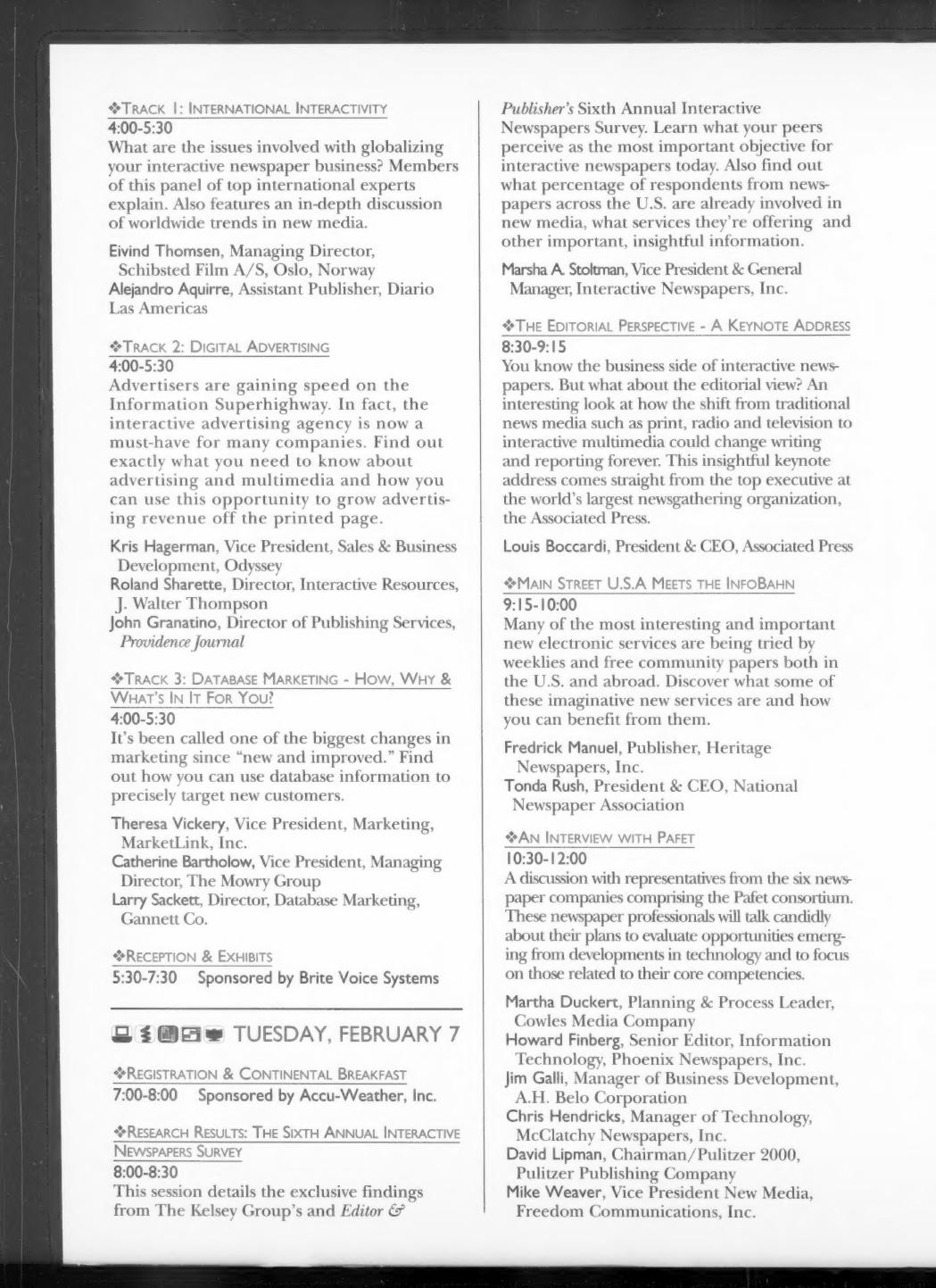
Asked about strategy over the next 24 months, I listed four areas: consumer acceptance, broadband delivery, directory publishing and transactions. Longer term, commerce systems and agency relationships — shared “ad space” with content partners. PAFET, the newspaper technology consortium, gets credit for access to experiences that would have been hard to duplicate, along with the strategic alliances with InfoSeek and Pointcast. On the money: about $2.3 million being spent CNI-wide, with a projected 10% expense increase for 1997 and capital spending estimated at $150,000.
The overview section reprints a piece I’d written for the first edition of an in-house newsletter, the Cyber Chronicles, aimed at a general newsroom audience:
While using a 17th Century technology — ink on paper — to communicate what’s happening with PNI’s online efforts may seem strange, it helps make the point that the newspaper isn’t going away. Frankly, there are just some things you can do better on newsprint.
Arizona Central ran two editions — one on the Web, one on America Online — and a good part of the internal confusion was about why we bothered with both. The answer in the report is blunt:
We are often asked, “Why have any content on AOL?” The reason is simple: It reaches a different audience than the Internet.
AOL was then the world’s largest commercial online service with six million customers, sharing market revenue with PNI and paying bounties for each customer we signed up with a special Arizona Central disk. The distinction I drew was between “the technically advanced” — comfortable with IP addresses and hunting on the Web — and “the technically evolving,” who preferred the safer environment of a commercial service.
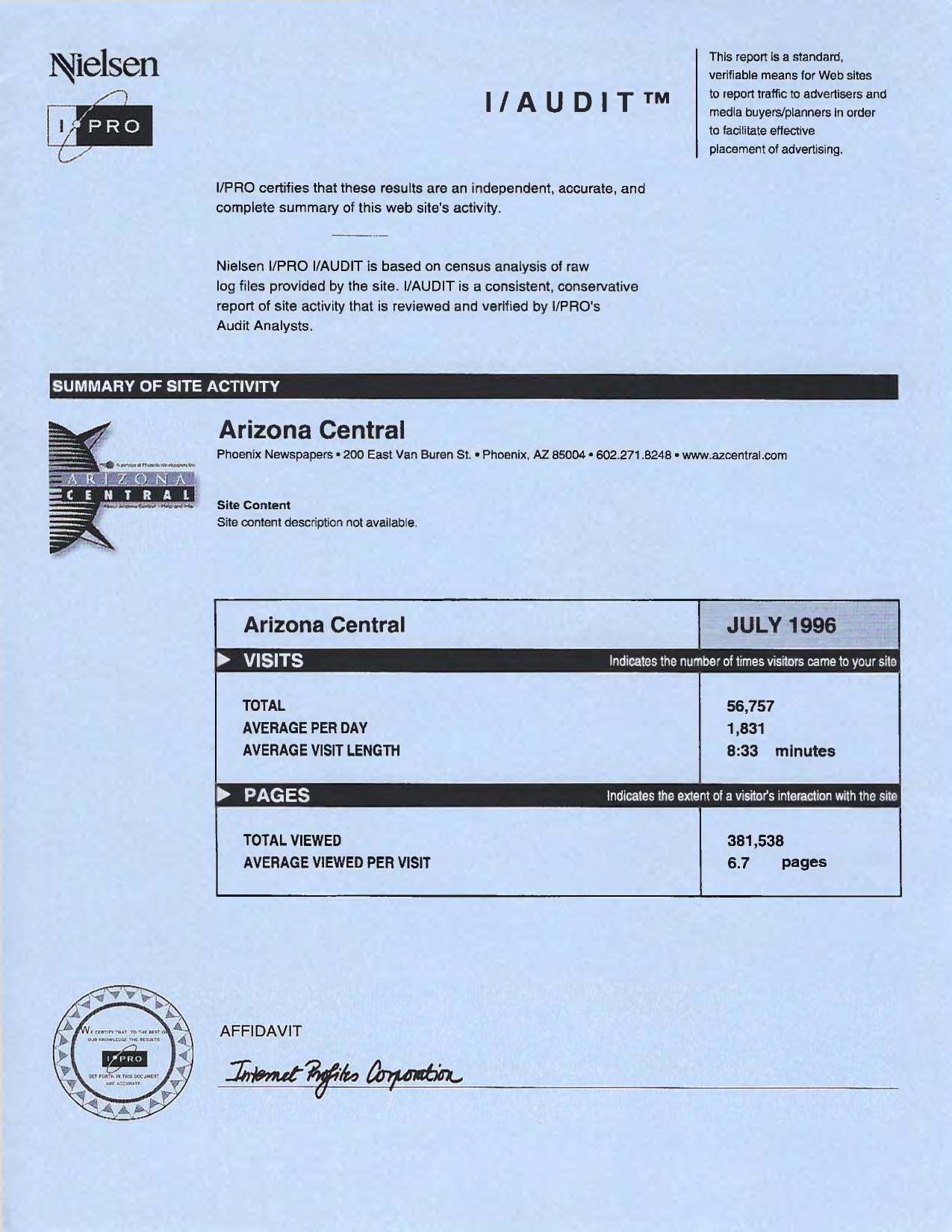
The traffic charts are a reminder of how crude measurement was. Web numbers were “hits,” with a note that our pages used only three or four image files while boston.com used 19 on its home page — so our hit counts looked small by comparison. The big spike came from putting employment liners online in late June; the flattening was blamed on the Olympic games, a drop seen across AOL as well. AOL, at least, could count actual paid entries into Arizona Central. Median age was 43.7 on AOL and 43.5 on the Web, and the daypart charts show AOL peaking at 8 p.m. while Web use tracked working hours — traffic from major Valley employers and corporate sites around the country.
The project list is the part I still enjoy: movie times, Living Here, Meet Your Match, calendars formatted for database searching, Prep Stats, Holiday Lights with the Downtown Association, and a SAVE system to search and purchase past stories. And the honest bottom line, stated up front:
While it is unlikely that online will be profitable this or next year, revenue is running ahead of projections.
Thirty years on, what strikes me is how much of the argument was about audience rather than technology — where readers actually were, and the willingness to publish in two places at once to reach them. That part of the job hasn’t changed at all.