Techno-Evangelism: Thoughts for Newsroom Leaders

Dealing with technology at The Arizona Republic, especially the introduction of new computer systems, led to a number of presentations about what I called “techno-evangelism.”  I wanted newspaper managers to pay more attention to technology and its impact upon their staff members and workflow.

Some of my key ideas, from a talk given at the Society of Newspaper Design’s 1993 convention in Dallas, were these five points:

1. Technology is an ecological issue. By itself, technology adds nothing. Its introduction changes everything.

2. A newsroom learns by example. If a newsroom manager isn’t willing to invest time or energy in understanding technology, don’t expect the staff to care.

3. The key issue about technology isn’t hardware or even software. It’s workflow. Understand the how work moves (or how you want it to move) through the newspaper and you’ll understand what technological solutions you’ll need.

4. Techno-evangelism means finding a leader who will take risks, become a teacher, shoulder responsibilities and be willing to go wandering in the “desert.”

5. Looking at history can help prepare you for the future. Understanding when there is a “paradigm” shift is important; knowing when there isn’t is even more important. Going from hot type to cold type is evolutionary; going digital is revolutionary.

I also handed out a technology adoption quiz.  Taking the quiz would identify whether you are a techno-phobe, a techno-boomer, a techno-to-go or a techno-wizard.

The slides from the presentation are here.


Training that Changes Your Life: API Seminar

In early 1991 John Oppedahl, The Arizona Republic’s managing editor, nominated me to attend the American Press Institute seminar for Managing Editors [newspapers over 77,000 circulation] in Reston, VA.   That seminar did two things: 1. Strengthened some of my leadership skills and confidence and 2. Created some life-long friends.

Like most API [and Poynter] seminars there was lots of “homework” and instructions ranging from accommodations to laundry.  From the acceptance letter:

So your nominee may arrive thoroughly prepared, and for your newspaper to derive maximum benefit for the outlay of training dollars, may I respectfully suggest a day be set aside from regular duties so homework assignments can be completed.

Before members return home, I urge them to sift through the many materials collected while at Reston, with a view to conducting a mini-seminar for fellow staffers so the entire department many benefit from their API experience. I hope you’ll consider giving the process a try, assuming you don’t already have it in place.

Of course, I don’t remember getting too much time off from regular duties but it didn’t really matter.  It was fun and always best to be prepared.

Mr. Media Interviews Mr. NewsU

Bob Andelman, also known as Mr. Media, does lots of interviews — celebrities from film, TV, books, music, and more.  I was one of those “more” interviews.  He did a podcast interview as Poynter News University was starting to gain traction.  It didn’t hurt that Bob and I knew each other via a connection with Bill Mitchell, who was Poynter Online editor.

Full disclosure: I hired Bob to write two whitepapers about Poynter’s e-learning work.  However, he thought what Poynter was doing with NewsU was interesting enough to do the podcast interview.  One of my favorite things about Bob’s work was the Dr. Seuss-inspired rhyme, which I recorded for NewsU. [Sadly, I’m not sure I know where that resides].  Here’s the text:

You can do it wearing a hat.
You can do it with your cat.
You can do it at night,
And you can do it when you look a fright.
You can do it when things are slow,
Or when you can’t get the creative juices to flow.
You can do it when mother’s not there,
And you can do it in your underwear.

You can read the full interview on Bob’s Mr. Media site and there’s even an audio of interview.

Sad postscript: Bob died in early 2020.  He is missed. A great deal.

Journalism Should Give Voice to the Voiceless

As part of the development of The Poynter Institute’s international strategy, I traveled to Istanbul with colleague and friend Vicki Krueger.  We launched Poynter NewsU Turkiye at a news conference.  At that event was our partner, the Media Association, and the US Consulate in Istanbul.  The Consulate is the funder for the project.  After the news conference I was interviewed by the local English-language newspaper, Sunday’s Zaman.  Here’s part of what they wrote:

According to Finberg, journalism means “providing voice to the voiceless” and is a way of helping people understand what is going on around them. “Journalists are responsible for protecting the interest of the audience, citizens,” Finberg said when asked whether the journalists have a duty to protect state interests.

Journalists in Turkey have a difficult time, as the country is undergoing political stress and strain that often pits one media organization against another.

The full interview is on the newspaper’s Website , or at least it was. Better to access it as a PDF.

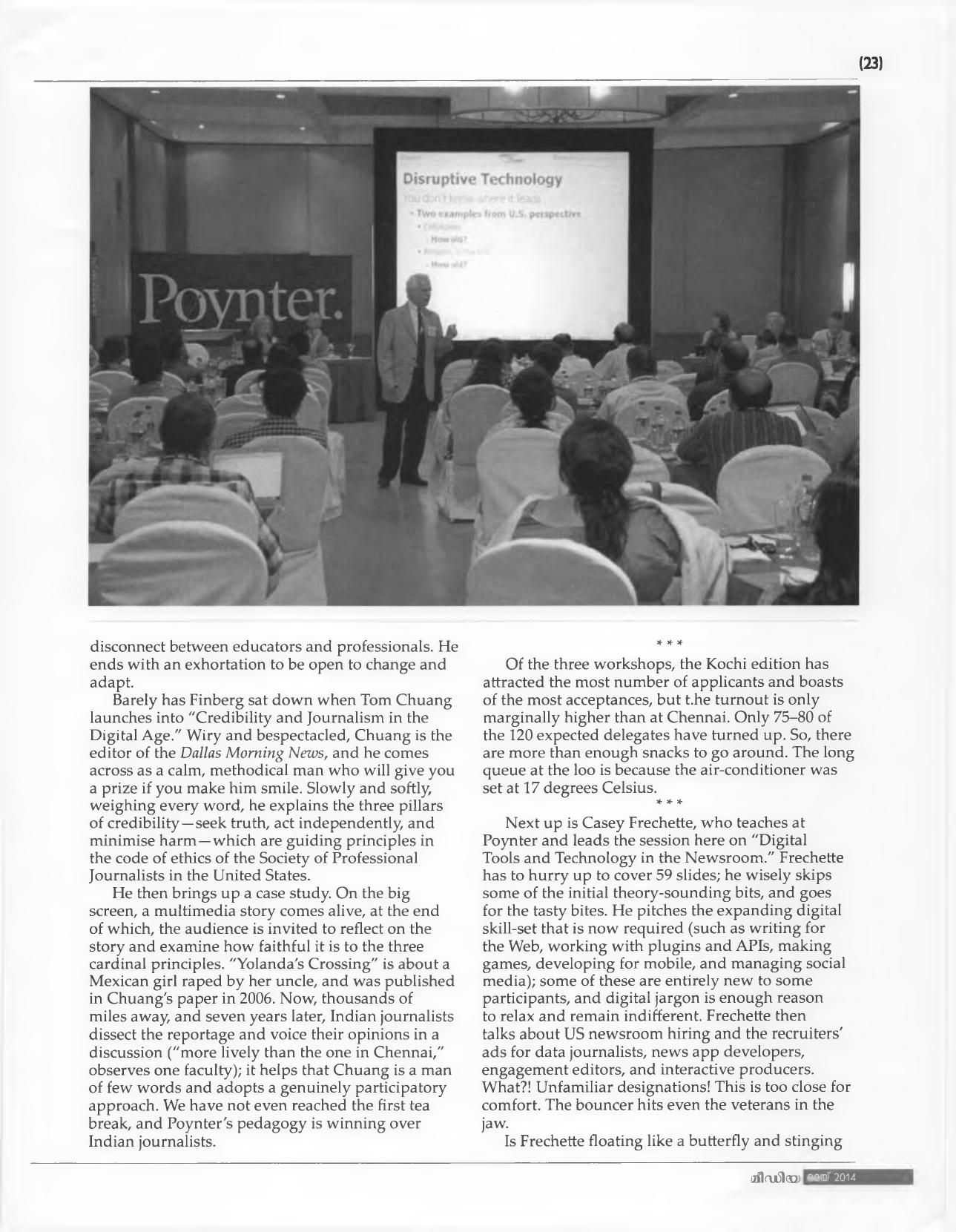
Poynter faculty and Indian journalists gathered for the traditional group photo at the Kochi workshop, Taj Gateway, March 2014

Points to Poynter: Report on Our India Workshop

In March 2014, Poynter took its teaching on the road to India — three three-day workshops, one each in Chennai, Kochi and Bengaluru, done in partnership with the U.S. Consulate. We covered more than 500 miles in the process. The Kochi workshop was organized with the Kerala Press Academy and ran March 23-25 at the Taj Gateway.

What makes this document historically interesting is that it isn’t ours. It’s a report by Ashok R. Chandran, an independent journalist and researcher in Palakkad, Kerala, who sat through all three days in Kochi and then wrote up the whole thing session by session — with a great deal more style and mischief than any of our own after-action summaries. He describes the workshop as something to zip through, seatbelts fastened, and the reader really does get carried along.

The report opens Day 1 with a detail that tells you exactly what era we were teaching in: a participant tweeting from the room while the inaugural speeches were still going, using a hashtag the faculty had created for the students.

My own session kicked things off with disruption: Clayton Christensen, the collapse of U.S. newspaper advertising revenue, and then findings from The Future of Journalism Education 2013 report and a preview of Core Skills for the Future of Journalism, which was released the following month. The through-line was the gap between what professionals value and what journalism educators value, a gap that looked much the same in an Indian classroom as it did in an American one.

Chandran was kind about the session. Mostly.

It is not every day that one gets to see in this part of the world, an energetic 70+ educator enlightening the audience on “The Exciting, Changing Future of Journalism.”

I’ll happily take “energetic.” The rest of the faculty got sharper portraits: Tom Huang of The Dallas Morning News on credibility, story ideas and finding focus; Casey Frechette on digital tools and how to teach them; Zella Bracy of McClatchy on the business side; Jeffry Couch of the Belleville News-Democrat on transformational newsrooms and watchdog journalism; Sue Burzynski Bullard of the University of Nebraska on Twitter as a teaching tool and on digital ethics. And Vidisha Priyanka on multimedia, whose session Chandran renders as an action movie. I was tweeting from the room too:

@vidisha71 owns the room talking about multimedia at #PoynterIndia workshop. Lots of teaching.

The most valuable passage in the report, and the most uncomfortable, is the Day 2 session on editorial-business collaboration. Our faculty pushed for newsrooms to work across the old firewall; the Indian journalists in the room pushed back hard, describing the phenomenon of paid news and citing what the Times of India’s Vineet Jain had told the New Yorker: “We are not in the newspaper business, we are in the advertising business.” Chandran’s verdict on the exchange is blunt.

The faculty see a storm coming but apparently misread it as part of century-long rivalry between journalists and marketers in media houses.

He also notes that the session then turned genuinely two-directional, ending with what he calls a Gandhian compromise — collaboration for need, but not for greed. That’s the part I keep coming back to. We went to teach and got taught, which is the honest outcome of any cross-border training worth doing.

He closes with the group photo — “It is a Poynter tradition,” I told him — the certificates, and a feedback session that ran hot instead of polite, recorded by a room full of phone and iPad cameras. His last line is the headline of the piece:

The future is in digital, and the Malayali journalist is already there.
Running Technology at Phoenix Newspapers

In early 1997 I took on the assignment of running Phoenix Newspaper’s technology department for an 18 to 24-month period.  The goal was to bring some of my strategic thinking to the daily operational aspects of the department.

Here’s what John Oppedahl, PNI’s publisher and chief executive officer is quoted in the Arizona Republic story about the announcement:

“In essence,” he said, “we are restructuring the information services department to address some of our operational challenges and provide better service to all PNI departments.”

Here’s what I said:

“I’ve had the strategic view of technology and its importance to the company…The goal now is to get us in a position to go into the next century, and to use technology to better serve our customers.”

Customers, always the key to success.

Newspapers and the Dilemma of Innovation

It was clear, even to me, that by the early 2000s, the newspaper industry would be facing its greatest challenge.  The disruption was widespread in many industries and there were lessons from book publishers, record companies and even the steel manufacturers.

I gave a presentation at media-convergence workshop sponsored by The Media Center at the American Press Institute at Newspaper Association of America’s technical conference, NEXPO, in Orlando, June 21.

As reported in TechNews, the NAA’s convention daily, I said the newspaper industry

 … sits at an “inflection point,”where disruptive technologies surround the medium and demand that companies “throw off the existing culture and methods of doing business.

“Our customers  are getting smarter. Their expectations are higher,”he said.They want to do business in their time, not yours,”aided by forces of disruption,”such as cellular-data services, instant messaging and real-time businesses.

Some of this presentation referenced one of my favorite books, The Innovator’s Dilemma by Clayton Christensen.


Preparing Newspapers for Third Wave of Technology

At the invitation of Olivia Casey, I was invited to write an article for the “ASNE and SND Technology Survey ’96” report.  My topic was on the impact of technology and pagination upon the newsroom and journalists.

One of my key points was the need for editors to take more active control of the issues around pagination and other technology:

The challenge for today’s newsroom managers is to look at these new technologies and see how they might reshape the landscape of news and information gathering and how to make plans to adapt to those changes. It is time to get proactive and stop being so reactive to the changes that have affected and will continue to affect newspapers.

My concept was that newsroom technology was about to enter into a new wave or stage that would be driven by databases and computer systems that allowed for the easy storage and access of information bits and pieces. The industry’s attempts to modernize its backshop production can be divided into three
waves:

  • First wave – electronic paste-up
  • Second wave – electronic composition
  • Third wave – database publishing

Finally, I think I was pretty accurate about how journalists would need to be more generalists:

Where does that leave the journalist as specialist? My career advice is this – get new skills, learn new aspects of the business. This holds true whether you are a reporter or designer. In the future, newspapers will need more generalists, fewer priests guarding the gates of knowledge. These generalists will need the skills to deal with multiple forms of communication – the written word, the audio clip, still and video images. This new form of collaborative publishing will provide the potential of tapping a great number of people to assemble the news. And with more people involved, more and different ideas of how to inform, entertain and enlighten. That is the risk and reward of the third wave.

I also wrote a sidebar about how journalists need to think about the customer:

Tomorrow’s journalists — from reporter to designer to managing editor — must play an increasingly more important role in getting the customer to buy our newspapers, fax services and audio lines and to visit our online areas.  It doesn’t matter how good the content is if nobody reads it.

Again, its all about the customer.


Newspaper Training Days: It’s About the Learning

Shortly after the launch of Poynter’s e-learning platform, News University, I was interviewed by the Newspaper Association of America’s monthly magazine, Presstime.  The author, Teddi Dineley Johnson, used the 2002 Knight Foundation survey about training, as a way to explore how various organizations are dealing with training issues.

In an industry that prides itself on breaking the big story, newspaper executives were caught by surprise three years ago when a landmark study found that lack of training was the No. 1 source of job dissatisfaction–ahead of salary and benefits–among U.S. journalists.

Data from this survey actually helped me figure out the direction of NewsU and its conclusions were supported by Poynter’s own research on the topic.

Here’s what I had to say about training:

“It’s all about getting smarter,” Finberg says. “It’s not about a grade, not about an application, not about a certificate. It’s about learning and, ideally, the kind of learning that’s important to your job.”

Some interesting historical notes:

* There were lots of references to the American Press Institute’s training programs.  API has evolved into more of a ‘think tank’ and no longer does traditional seminars.

* NewsU stats: 4,500 users; as of early 2014 there are more than 280,000 users.

* NAA’s online training efforts at naauniversity.org is gone.

Such is the evolving nature of training for the newspaper industry.

Poynter NewsU Registers 100,000 Users. First Big Milestone

When I wrote the original grant request to the Knight Foundation to create an e-learning program at The Poynter Institute, I put in estimate about how many people would take courses.  It was one of my greatest lapses in predicting success, as I thought we might have 35,000 users by the end of the five-year grant.

After four years, we passed the 100,000 registered user milestone.  In March we launched a marketing campaign thanks to the efforts of Susan Crain of LTV Marketing and Vicki Krueger, my deputy. Part of that campaign involved a press release and a paper called “NewsU Servcs Global E-Learning Audiences.”

We also ran a contest to gather stories about how NewsU change the lives of its users.  My favorite was a reporter at newspaper in the northwest:

“I credit NewsU for helping me do my job better than I could on my own, giving me courage to try new things,” says Sheila Hagar, a reporter for the Walla Walla (Wash.) Union Bulletin. “I don’t feel alone when I take a class.”

One of my goals, not yet realized, was to find a way to create a community around people who took NewsU modules.  I still have hopes that this will happen.

“The idea is to create a sense of community for those who want to share and ask questions of their fellow participants,” says Howard Finberg, director of interactive learning at The Poynter Institute. “You could call it a learning network. Your training should be much more than what’s on the screen.”

Editors Told Big Changes Needed. Did They Listen?

Even though it was 2007, I was still making speeches to editors [and publishers] about the need to embrace change and transform the newspaper business.  One such plea for change was made at a Texas Associated Press Managing Editors convention in San Antonio. A fellow trouble-maker at the event was Michael P. Smith, executive director of the Media Management Center at Northwestern.

I said that not even popular online sites can rest easy and the challenge is young people who aren’t newspaper readers.  And I talked about “control”  of content and media.

From a story published in the San Antonio Express-News:

And editors can’t forget they’re dealing with an audience that’s “digitally equipped,” as more people own devices that give them control of a medium such as digital video recorders like TiVo.

These digital devices give control.

“No one wants to give up something that gives them control, Finberg said.  Young people, especially, “want to take somebody else’s content and add to it.”


Come Together: Defining the Complementary Roles of Print and Online

In 2001 I worked with the Newspaper Association of America’s circulation federation to develop a report on how print and online departments could work together to further the sales of subscriptions.  Working with me on the project was my consulting partner at that time, Leah Gentry.

From the report’s opening:

… the NAA Circulation Federation began looking at how consumers use print and online news sources and how their choices affect our business. We began looking at the challenges and opportunities both media would encounter as this new consumer channel developed.

Here’s what we wrote for the introduction to the report, which runs 72 pages.

Newspaper marketing executives confront more challenges and opportunities as the media landscape evolves at an ever-increasing pace. No longer can our audiences be solely identified as newspaper readership; online also is becoming an important path for customers to access news and information. As our customers select from an increasing number of routes to us, we conversely enjoy expanded opportunities for marketing to them through multiple routes and for using each platform to strengthen its siblings.

When we wrote the report, pay walls and online subscriptions were just a glimmer on the digital horizon.

The report is too large to load here, so I’ve put in my SlideShare account.

Saying Goodbye to Great SF Chronicle Photographers

One of my great joys working at the San Francisco Chronicle was the photography department.  I was the first real photo editor at the paper and one of my goals was to improve the opportunities for the photographers to contribute to the paper’s journalism.  [Before I arrived at the paper, photos were often dropped off at the news desk into a wooden box.  I like to joke that I put that box out of a job.]

The photo department did a visual goodbye when I left for The Arizona Republic in June, 1987. It was a great team of friendly and hard-working journalists.  These photos are by Gary Fong, the chief photographer.  Gary and I remain friends.  He is in the front row, in the center.

On the far left side is another friend, Bryan Moss.  I hired Bryan as a food photographer, with no experience in food photography. But that’s another story.


Learning Culinary Confidence

And now for something completely different. 

During the “sectional revolution” at the Chicago Tribune, there was an opportunity for those with a little extra time and some energy to write articles for the paper’s new feature sections.  Since I liked food, I offered a couple of different stories, including a review of  high-end hamburgers.  I also got an opportunity to write about a newly developed passion for cooking and took a cooking class.

Like most Americans, I was raised on a steady diet of meat and potatoes, all cooked in the same basic manner: unexciting. It wasn’t until I opened the doors to a variety of food palaces here and in San Francisco that I began to enjoy food, even look forward to it! But eating out  puts  a cramp on the  budget.

So confronted with bankruptcy or more meat and potatoes, I took up ethnic cooking and soon discovered that all knowledge does not come from a cookbook. I decided it ’twas time for a cooking class.

It was a fun class and lessons learned are still applied today.  And it was a fun assignment to write about my experiences.

NewsU Makes the Connection to Educators at AEJMC

The initial plan for News University, the e-learning site created at The Poynter Institute and funded by the Knight Foundation, was to focus on professional.  We didn’t think there we had much of a role to play in helping educators.  That turned out to be wrong.  And by the time I presented NewsU to educators at the Association of Educators of Journalism and Mass Communications [AEJMC], we knew our e-learning would be helpful in training the next generation of journalists.  Here is a tidbit from the AEJMC Reporter, which was the convention newspaper:

hif pyramid of training reach 08_03_2006
The Pyramid of Training Reach at AEJMC 2006

“Initially, NewsU was about professionals, but we wanted to reach out to the academic community,” said NewsU director Howard Finberg during a presentation Wednesday. “We did this for two reasons. First, journalism students become journalists. We want to get them early. Secondly, teachers need help.”

This presentation was one of the first public showing of my “Pyramid of Training Reach,” a device to help explain how different training methods have different audience potential and different intensity of experience.