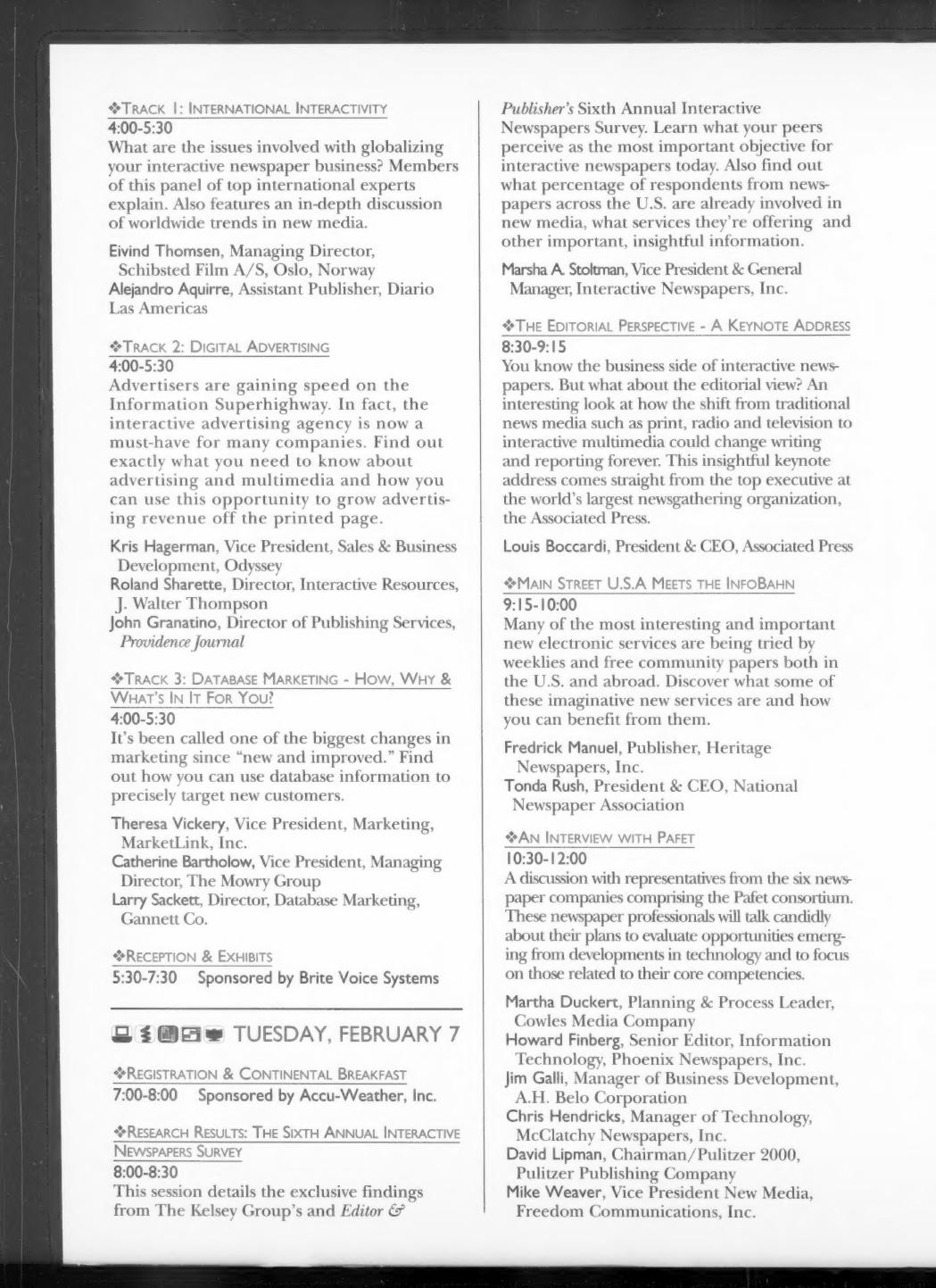
Interactive Newspapers conference program page listing the Pafet consortium panel and its six newspaper company representatives

Pafet Goes Public at Interactive Newspapers Conference

The conference program for the interactive newspapers gathering — built around The Kelsey Group’s and Editor & Publisher’s Sixth Annual Interactive Newspapers Survey — put the Pafet consortium on the Tuesday morning agenda, with a representative from each of the six member companies on stage.

AN INTERVIEW WITH PAFET
10:30-12:00
A discussion with representatives from the six newspaper companies comprising the Pafet consortium. These newspaper professionals will talk candidly about their plans to evaluate opportunities emerging from developments in technology and to focus on those related to their core competencies.

I was there for Phoenix Newspapers, one of six panelists listed:

Martha Duckert, Planning & Process Leader, Cowles Media Company
Howard Finberg, Senior Editor, Information Technology, Phoenix Newspapers, Inc.
Jim Galli, Manager of Business Development, A.H. Belo Corporation
Chris Hendricks, Manager of Technology, McClatchy Newspapers, Inc.
David Lipman, Chairman/Pulitzer 2000, Pulitzer Publishing Company
Mike Weaver, Vice President New Media, Freedom Communications, Inc.

The rest of the program is a nice snapshot of what the industry was worried about at the time: international interactivity, digital advertising, database marketing, and a keynote from Louis Boccardi, President & CEO of the Associated Press, on what he called the editorial perspective. My favorite session title on the page: “MAIN STREET U.S.A MEETS THE INFOBAHN.”
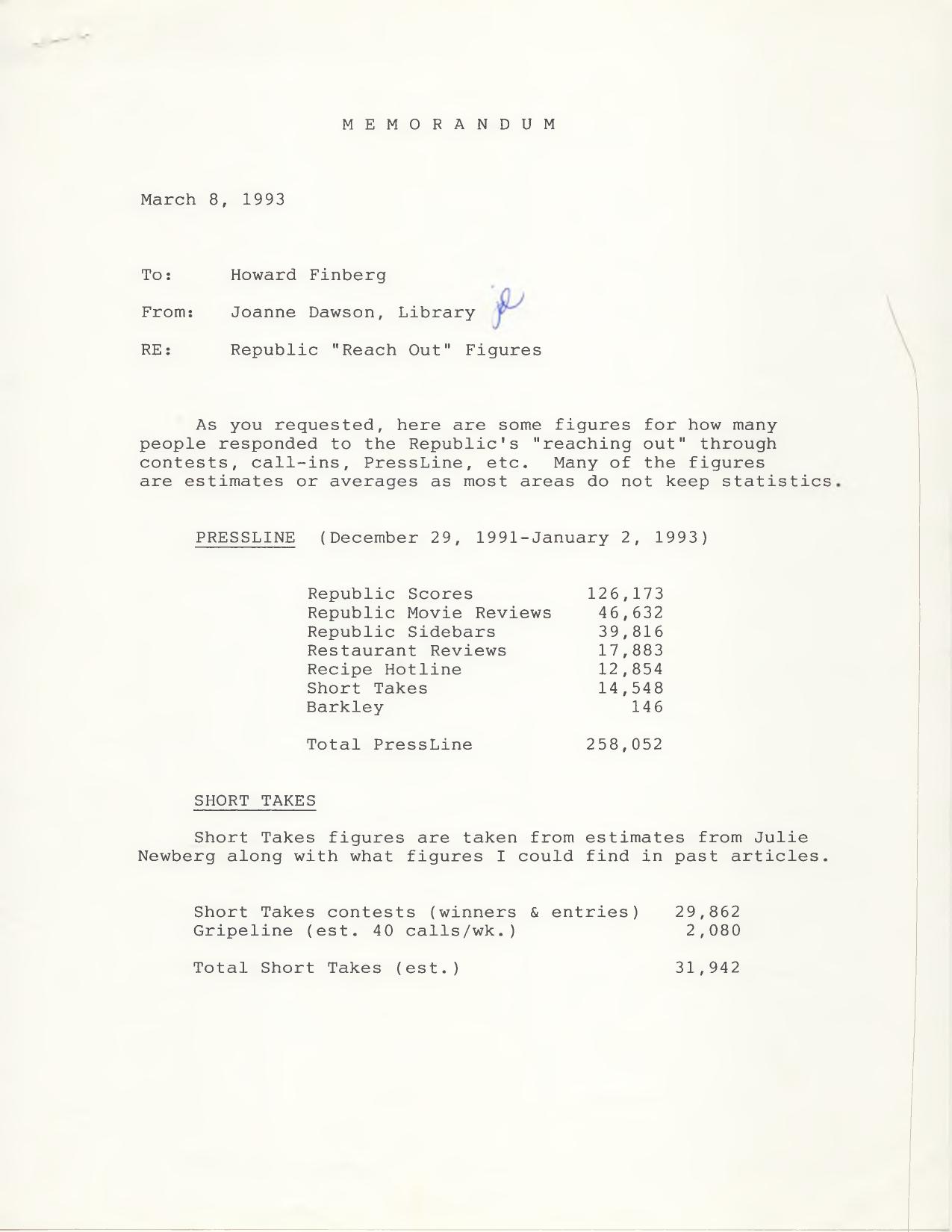
Typed 1993 memo from the Arizona Republic library listing reader response counts for PressLine, contests and call-ins

Reader Connections at the Republic

In early 1993 I asked the Arizona Republic’s library to pull together numbers on how many readers were actually responding to the paper’s various ways of inviting them in — contests, call-ins, the PressLine audiotext service. Joanne Dawson, the librarian, came back with this tally, along with a sensible caveat about the state of the data.

As you requested, here are some figures for how many people responded to the Republic’s “reaching out” through contests, call-ins, PressLine, etc. Many of the figures are estimates or averages as most areas do not keep statistics.

PressLine was the biggest piece, with 258,052 calls between December 29, 1991 and January 2, 1993. Sports scores dominated at 126,173, followed by movie reviews, sidebars, restaurant reviews and the recipe hotline. Short Takes, the Kids Page, sports phone-ins and a handful of contests filled out the rest.

GRAND TOTAL (est.) 334,790

What strikes me looking at this in 2026 is that almost nobody was keeping statistics. A third of a million reader interactions in a year, and most of it had to be reconstructed from old articles and someone’s best estimate of “40 calls/wk.” The audience was there and talking back — the newspaper just had no habit of measuring it. Web analytics would arrive soon enough and change that permanently.

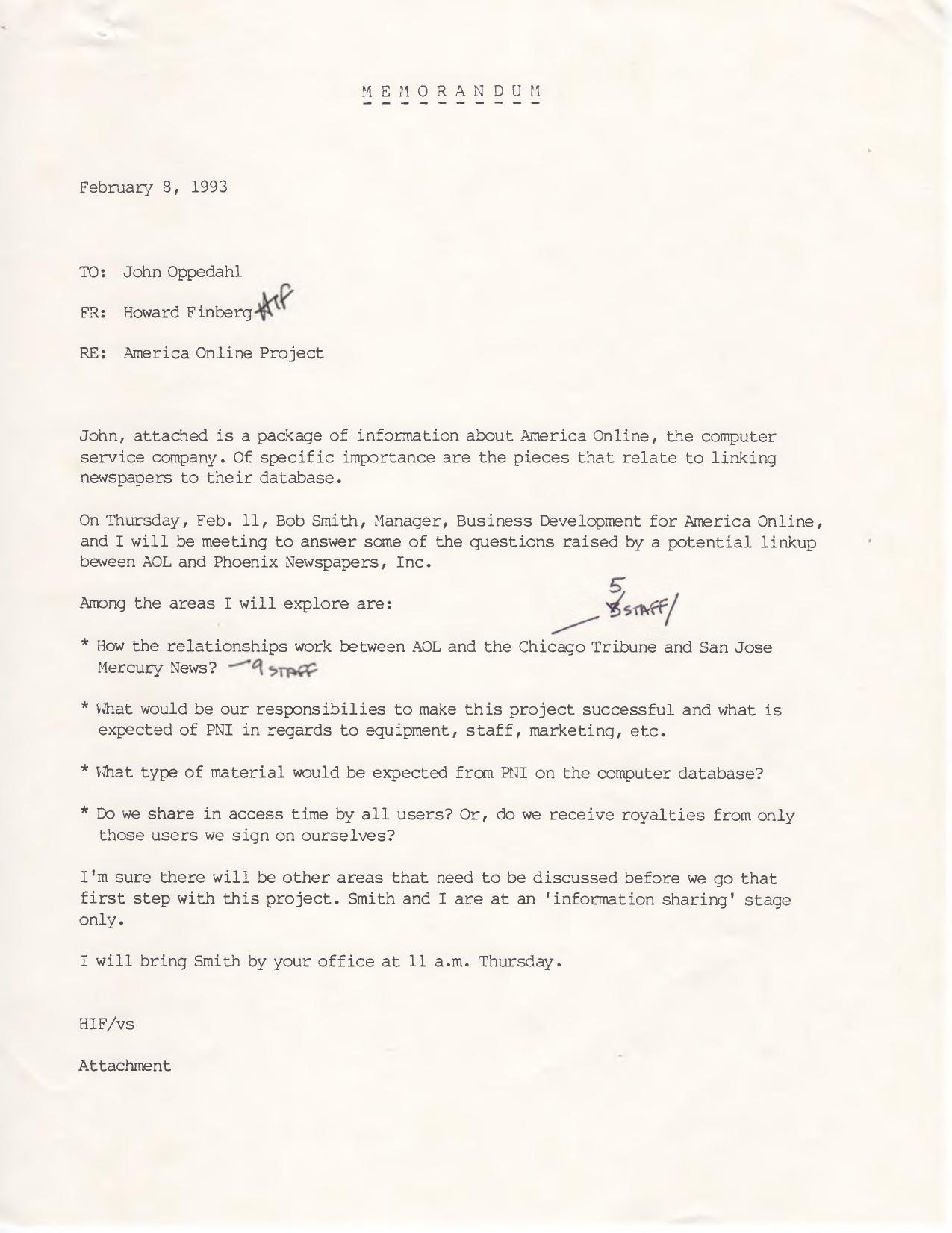
Typed 1993 internal memo to Phoenix Newspapers executive John Oppedahl outlining questions for a meeting with America Online

An Early Look at America Online

This is a short memo I wrote in February 1993 to John Oppedahl, then an executive at Phoenix Newspapers, Inc., about a meeting I had scheduled with America Online. At the time, AOL was signing up newspapers to put content into its database, and I wanted to understand what such a partnership would mean for PNI before anyone committed to anything.

John, attached is a package of information about America Online, the computer service company. Of specific importance are the pieces that relate to linking newspapers to their database.

The meeting was set for Thursday, Feb. 11, with Bob Smith, Manager, Business Development for America Online. The questions I planned to ask were the basic ones any newspaper should have been asking in 1993 — and, honestly, the ones many didn’t ask carefully enough:

* How the relationships work between AOL and the Chicago Tribune and San Jose Mercury News?

* What would be our responsibilities to make this project successful and what is expected of PNI in regards to equipment, staff, marketing, etc.

* What type of material would be expected from PNI on the computer database?

* Do we share in access time by all users? Or, do we receive royalties from only those users we sign on ourselves?

That last question — who gets paid, and for whose audience — turned out to be the one the industry spent the next decade arguing about.

I was careful to keep expectations modest:

I’m sure there will be other areas that need to be discussed before we go that first step with this project. Smith and I are at an ‘information sharing’ stage only.

The memo closes with the smallest of logistical notes: I would bring Smith by Oppedahl’s office at 11 a.m. Thursday.

Postscript: Phoenix Newspapers did sign an agreement with America Online.