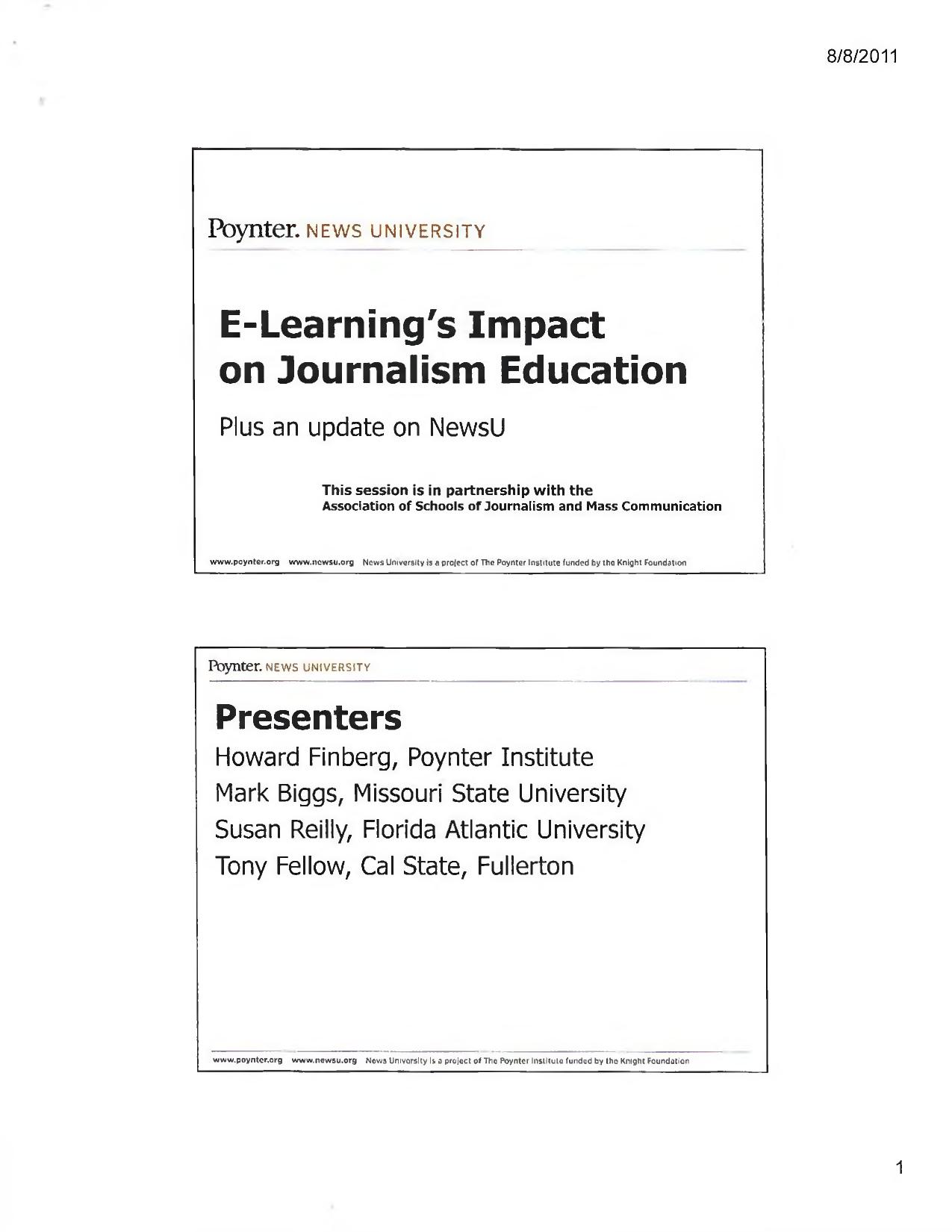
These are the slides I used for a presentation about e-learning, given on August 8, 2011. The session was run under the NewsU banner and, as the title slide notes, was done in partnership with the journalism education association:
This session is in partnership with the Association of Schools of Journalism and Mass Communication
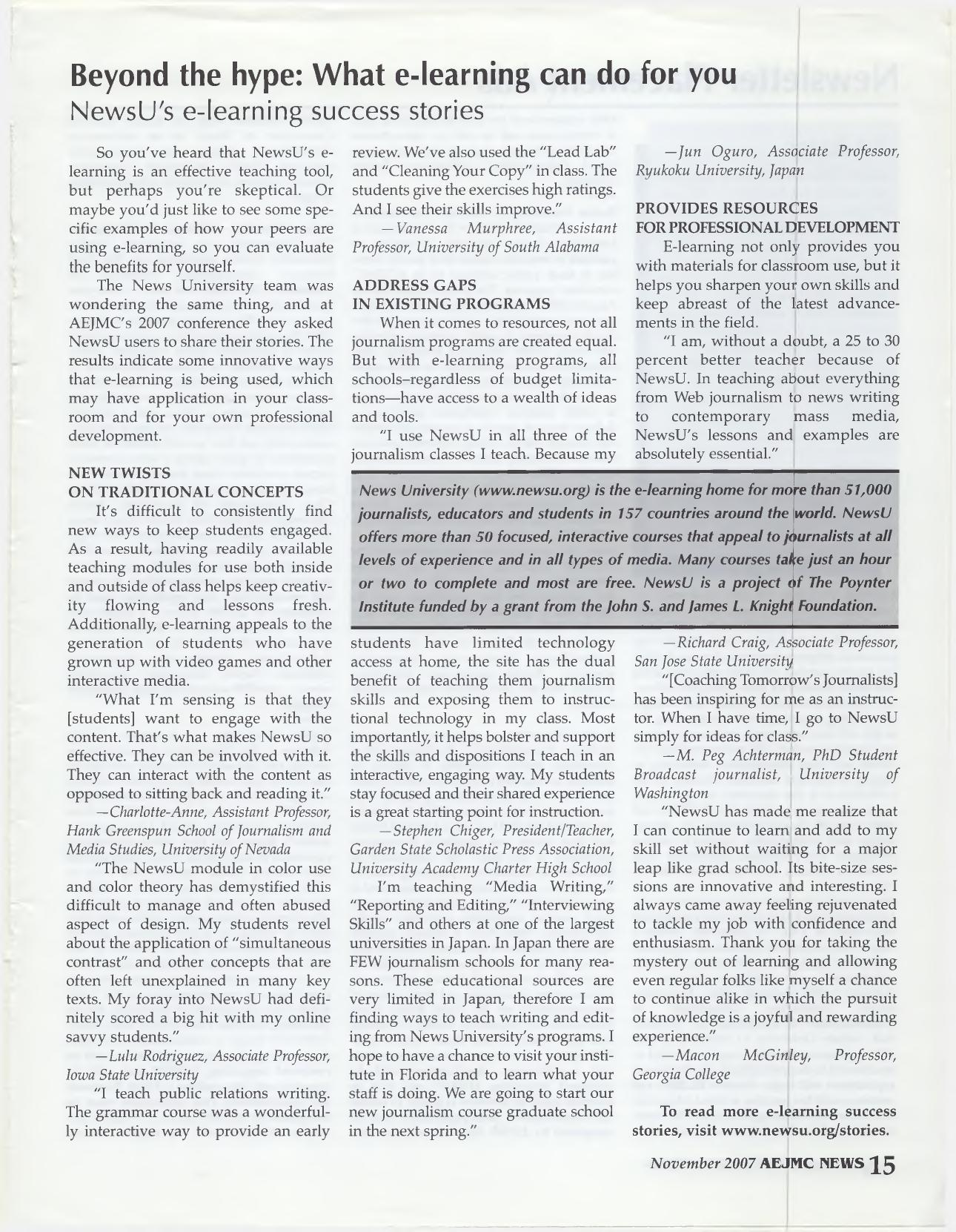
I wasn’t alone on the platform. The presenters slide lists:
Howard Finberg, Poynter Institute
Mark Biggs, Missouri State University
Susan Reilly, Florida Atlantic University
Tony Fellow, Cal State, Fullerton
The first half of the deck is about the J101 Project — an attempt to take NewsU‘s self-directed modules and online group seminars and build them into a semester-long introduction to journalism course taught in partnership with universities. The background slide describes the idea as leveraging self-directed modules plus online group seminars, working with schools on journalism education quality, intersecting with Carnegie Corporation interests, and running as a pilot program grant.
What made J101 different was the weekly rhythm. The “How it works” slide lays it out:
Read two essays • Self-directed course(s) and other Virtual Textbook materials • Tuesday Live Lecture or the replay • Study Group Work assignment • Study Group discussion • Thursday Live Chat • Weekly quiz
Several slides show the course itself — a 16-week virtual textbook running from “Who Is News?” and “Intro to Reporting” through interviewing, alternative story forms, dealing with diversity, style, rewriting, libel and privacy, news-gathering legality, and the business of journalism. There are pre- and post-assessments, weekly assessments drawn from a randomized pool of questions taken from the NewsU modules, the live lecture and the weekly readings, and a 50-question final exam scheduled for December.
The instructor dashboard got its own pair of slides, and for good reason. We were tracking logins and time spent in both the main course and each related self-directed module, weekly assessment scores, class participation and discussion posts, attendance at the weekly Live Lecture and Live Chat, and the final exam score. As the slide says plainly:
We are tracking lots of data
Our goals slide was less about the mechanics and more about the ambition — a unique educational experience leveraging the expertise of Poynter, closer relationships with universities, and a marriage of online group seminars, webinars and self-directed training. The second goals slide is the one I’d still stand behind:
Create lifelong learners • Increase the understanding of the role of journalism – No matter what students choose as their profession • Work more closely with universities
Partners for the pilot were Florida Atlantic University, Missouri State University and California State University, Fullerton, and we used the session to recruit partners for Spring and Fall 2012.
The second half of the deck is the NewsU stakeholders report. At our core was self-directed training, with more than 70 modules. New courses launched or launching that August included Sports Reporting: Beat Basics, Producing for TV & Web, Sourcing & Verification, Journalism Fundamentals, Introduction to Reporting and Covering Islam. We had just done our 100th webinar, ran a 10-session Writing Webinar Series in 2011, offered certificate programs in journalism basics, reporting and writing basics and multimedia basics, and were piloting a “Course Pack” with USF reporting classes — five modules with assessments worth 15% of a student’s grade. The Syllabus Exchange had drawn 200+ uploads and 900+ downloads.
And then the number, as of 6 a.m. the morning of the talk:
186,667 registered users
We were counting to 200,000, with a “Make Your Story Count” contest asking users to tell us how NewsU had helped them do better journalism. The deck closes with the next frontier: NewsU International, in partnership with ICFJ, launching in Persian and Russian, with 15% of NewsU users already outside North America.