2005 Study of Print & Online Newsroom Roles
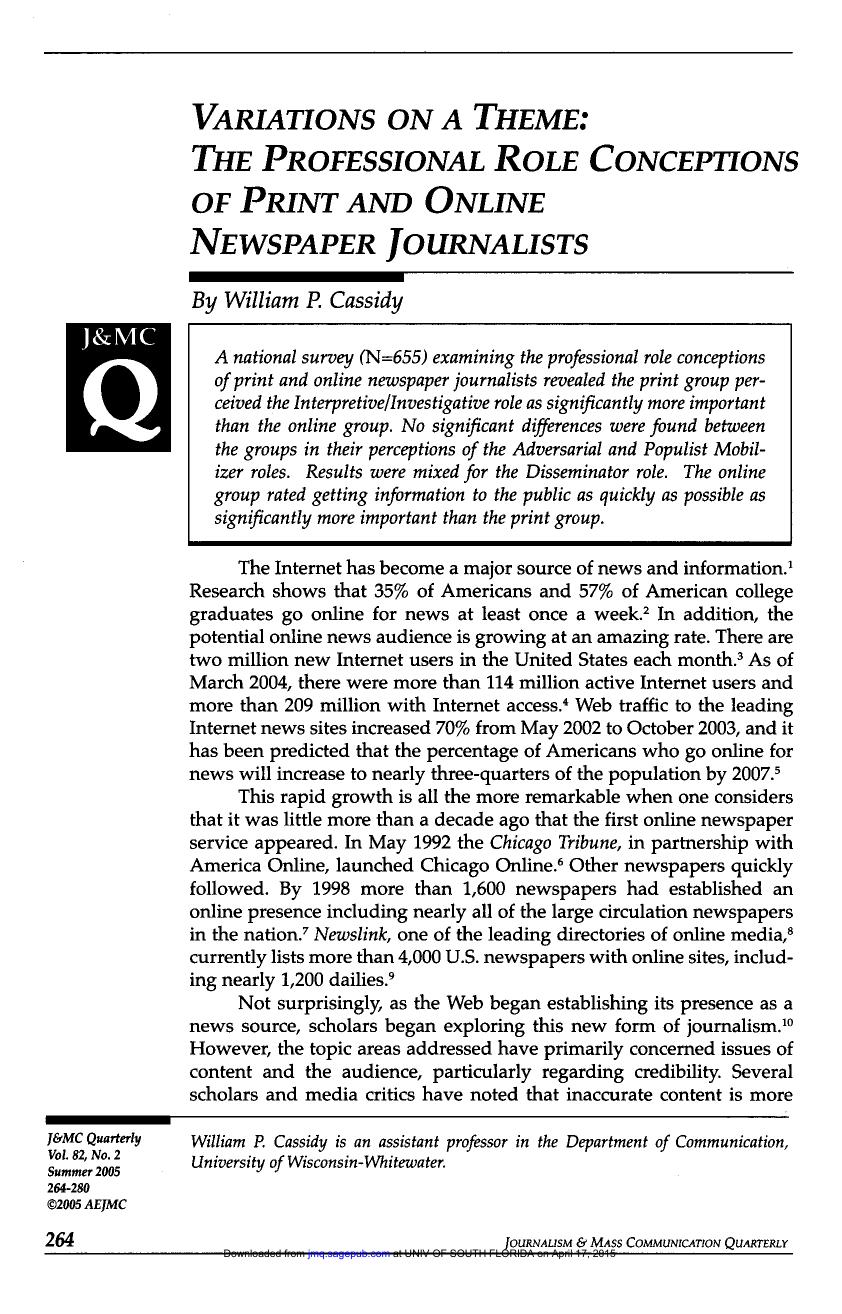
This is William P. Cassidy’s article “Variations on a Theme: The Professional Role Conceptions of Print and Online Newspaper Journalists,” published in Journalism & Mass Communication Quarterly, Vol. 82, No. 2, Summer 2005, pages 264-280. Cassidy was an assistant professor in the Department of Communication at the University of Wisconsin-Whitewater; the data came from his 2003 Ph.D. dissertation at the University of Oregon.
The question behind the study was one the industry was arguing about at the time without much evidence: were online journalists a different species from their print colleagues, or the same people working at a different speed? Cassidy went at it with a national Web-based survey, sending 3,330 invitations between July 15 and August 25, 2003, and getting 655 usable responses — 456 print newspaper journalists and 199 online newspaper journalists — from 271 newspapers in all 50 states and the District of Columbia. The response rate was 23.1%.
He measured the responses against the four role conceptions Weaver and Wilhoit had established: interpretive/investigative, disseminator, adversarial, and populist mobilizer. The headline finding, from the abstract:
A national survey (N=655) examining the professional role conceptions of print and online newspaper journalists revealed the print group perceived the Interpretive/Investigative role as significantly more important than the online group. No significant differences were found between the groups in their perceptions of the Adversarial and Populist Mobilizer roles. Results were mixed for the Disseminator role. The online group rated getting information to the public as quickly as possible as significantly more important than the print group.
In other words: print journalists scored higher on investigating government claims, analyzing complex problems, and discussing national policy (6.10 versus 5.74 on a seven-point scale). Online journalists scored higher on speed (6.46 versus 6.03). But on staying away from stories where the facts cannot be verified — the accusation most often aimed at online newsrooms in that era — there was no significant difference at all. Both groups took it seriously.
That last result matters, because the surrounding literature Cassidy reviews was full of the assumption that online publishing had corroded verification. He quotes Ann Brill’s characterization of the problem:
rush to production has allowed rumor to pass as reporting and electronic processing to pass for editing
Cassidy’s own reading of his data is gentler: “Perhaps online journalists are simply getting a bad rap from these journalists.” He suggests the online journalists in his sample, working for daily newspapers rather than Web-only operations, had absorbed the same newsroom norms as everyone else in the building.
I have a personal stake in this one. The credibility research Martha L. Stone, Diane Lynch and I did for the Online News Association — the “Digital Journalism Credibility Study,” published January 31, 2002 — is cited twice in the notes, in support of the point that the public rated online news about as credible as news from other sources. It is a small thing to find your own work in someone else’s footnotes, but it is a reminder that the arguments we were having inside newsrooms were also being tested, carefully, by people outside them.
The article also offers a useful bit of chronology for anyone dating the online news era, noting that in May 1992 the Chicago Tribune, in partnership with America Online, launched Chicago Online, and that by 1998 more than 1,600 newspapers had an online presence.
Reading this in 2026, the striking thing is that the study’s central dividing line no longer exists. There is no “print group” and “online group” to compare; there is a newsroom, and everything it publishes goes out digitally first. What has survived is the tension Cassidy measured — the pull between interpretation and speed. Twenty years on, with AI-generated summaries and an endless publishing clock, that tension hasn’t been resolved so much as industrialized.